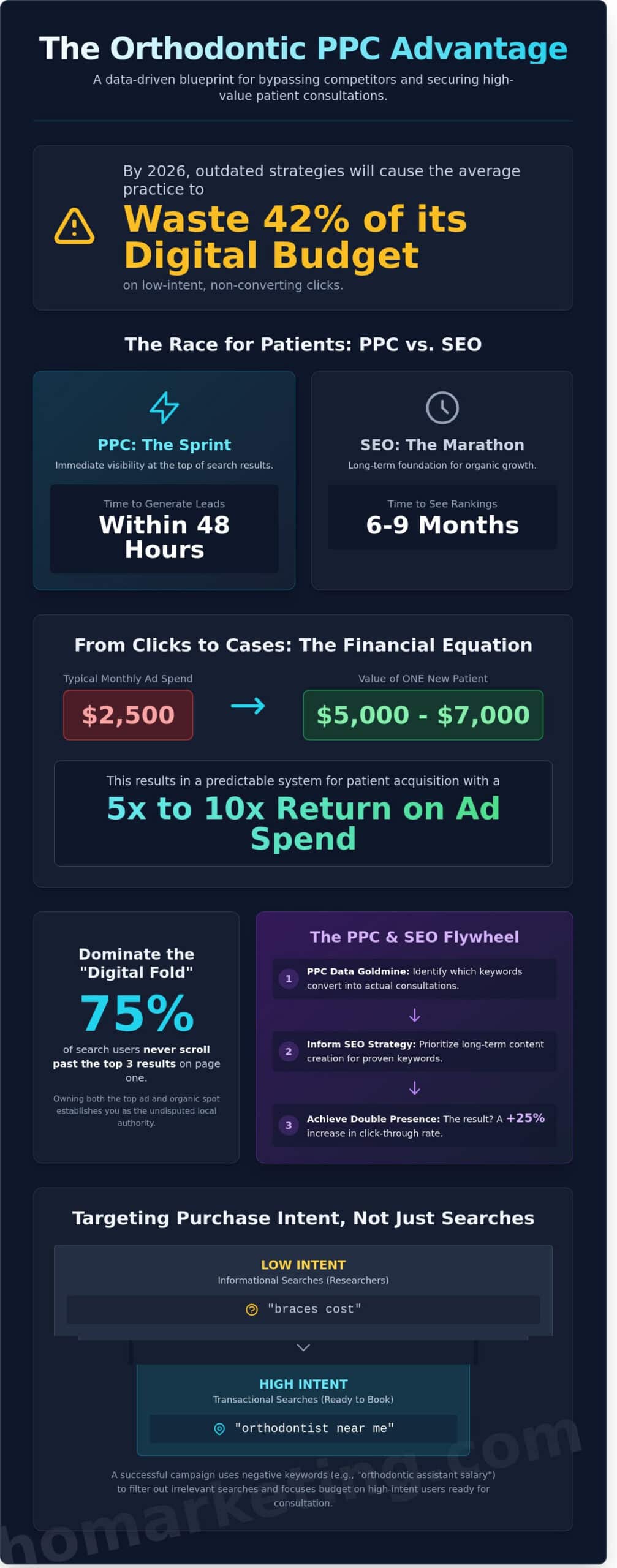
By 2026, the average practice will waste 42% of its digital budget on low-intent clicks if they rely on outdated bidding strategies. You’ve likely experienced the frustration of soaring CPCs in the dental niche or the headache of managing complex Google Ads accounts while focusing on clinical care. It’s discouraging to see leads enter your system only to disappear before the initial consultation. You shouldn’t have to choose between clinical excellence and business growth.
We’re here to bridge that gap. This specialized guide teaches you to master orthodontic ppc so you can bypass the competition and secure high-value consultations immediately. You’ll learn the exact framework we use to lower cost-per-acquisition by 15% and dominate local search results for your most profitable keywords. We’ll explore how to turn digital interest into a predictable flow of new patient starts through a proven, results-driven strategy that puts your practice growth in expert hands. It’s time to stop guessing and start growing with a strategy built for the modern orthodontist.
Key Takeaways
- Discover how to leverage specialized orthodontic ppc strategies to bypass competitors and secure high-value consultations while your long-term SEO matures.
- Learn to structure high-performance Google Ads campaigns that utilize AI-driven Smart Bidding to prioritize conversion quality for specific treatments like Invisalign and braces.
- Explore the benefits of integrating Local Service Ads and Meta Ads to build instant practice authority and capture leads across multiple digital touchpoints.
- Master the essential elements of high-converting landing pages that reduce budget waste by turning clicks into confirmed orthodontic appointments.
- Understand how a data-backed, custom framework can scale your practice faster by avoiding generic marketing templates in favor of specialized results.
Why PPC for Orthodontists is Essential for Immediate Practice Growth
Establishing a dominant online presence requires a dual-track approach. While organic growth is a marathon, orthodontic ppc acts as a high-speed sprint to the top of search engine results pages. At its core, Pay-per-click (PPC) is a targeted advertising model where you only pay when a potential patient interacts with your ad. This strategy allows your practice to bypass the months of waiting associated with organic rankings, placing your brand directly in front of parents and adults actively searching for smile transformations.
The “Immediate Results” advantage is the primary reason most successful practices prioritize this channel. Search engine optimization typically requires six to nine months of consistent effort before you see a significant climb in rankings. In contrast, a well-structured PPC campaign can generate high-quality leads within 48 hours of activation. It serves as the necessary bridge for new practices or those expanding into new territories, ensuring the chairs stay full while your long-term digital foundation matures.
Calculating the value of these campaigns reveals a compelling financial story. In 2024, the average national value for an Invisalign or traditional braces case ranges from $5,000 to $7,000. If your monthly ad spend is $2,500, a single treatment start justifies the entire investment. Most specialized campaigns we manage aim for a 5:1 or 10:1 return on ad spend. When you view marketing as a predictable system for patient acquisition rather than a nebulous expense, the decision to scale becomes clear.
Looking toward the 2026 landscape, the orthodontic niche is becoming increasingly saturated. Recent data indicates that 75% of search engine users never scroll past the first three results on page one. As corporate dental groups increase their digital budgets, specialized management becomes mandatory for independent practices. You cannot afford to rely on guesswork when your competitors are using data-driven systems to capture the local market share.
The Synergy Between SEO and PPC
Your paid campaigns provide a goldmine of data that should directly inform your orthodontist seo strategy. By analyzing which keywords lead to actual consultations, you can prioritize your content creation for organic growth. Dominating the “Fold” means owning both the paid ad spot and the top organic position. This double-presence increases your click-through rate by 25% because it establishes your practice as the undisputed local authority. Use PPC to test the viability of a new service area, such as a satellite office in a neighboring zip code, before committing to a year-long SEO campaign.
Identifying High-Intent Orthodontic Keywords
Success in orthodontic ppc depends on understanding user intent. A search for “braces cost” often indicates a researcher who is 12 months away from a decision. Conversely, a search for “orthodontist near me” signals a high-intent buyer ready to book a consultation this week. We treat “Invisalign” and “clear aligners” as separate campaign structures because the demographics and pain points for these users differ significantly. We also utilize robust lists of negative keywords to ensure your budget isn’t wasted on searches for “dental school jobs” or “orthodontic assistant salary,” keeping your spend focused entirely on new patient acquisition.
The Architecture of a High-Performance Orthodontic Google Ads Campaign
Building a successful campaign requires more than just picking keywords; it demands a structural blueprint that mirrors your clinical workflow. To maximize your orthodontic ppc results, you must segment your account into three primary pillars: Braces, Invisalign, and Pediatric Orthodontics. This separation allows you to allocate budgets based on the actual profitability of each service. For instance, if clear aligner cases yield a 35% higher profit margin than traditional metal braces, your campaign structure should reflect that priority. By isolating these categories, you prevent a surge in low-value “emergency repair” searches from draining the budget intended for full-treatment starts.
In 2026, high-performance campaigns rely on hyper-local precision. Data shows that 82% of orthodontic patients choose a provider located within a 15-mile radius of their home or workplace. We set strict geofencing parameters to ensure your ads only appear to users within this specific “commute zone.” This prevents wasted spend on clicks from distant leads who are statistically unlikely to commit to a multi-year treatment plan. Your ad copy must bridge the gap between clinical authority and emotional results. While patients care about your board certification, they’re truly buying the confidence of a transformed smile. Always ensure your claims are substantiated and align with the FTC’s advertising guidelines to maintain your practice’s professional reputation and legal standing.
Targeting the Right Decision Maker
Success in orthodontic ppc depends on knowing who holds the credit card. When targeting parents, your copy should emphasize long-term health, flexible financing, and convenient after-school appointments. For the self-conscious adult, focus on “invisible” options and the professional advantages of a straight smile. Use demographic layering to reach household decision-makers in the top 30% of your local income bracket. We also implement aggressive bid adjustments during office hours. If your front desk is only available to answer calls from 8:00 AM to 5:00 PM, your bids should be 20% higher during those windows to capture live engagement.
Leveraging AI and Machine Learning in 2026
Modern Google Ads rely heavily on Performance Max (PMax) and Smart Bidding, but these tools require high-quality fuel to function. You can’t just let the AI run wild. You must feed the system “First-Party Data” by uploading encrypted lists of your current high-value patients. This teaches Google’s algorithm exactly what a “good” lead looks like, reducing your cost-per-acquisition by as much as 18% within the first 90 days. Without this data, AI campaigns often chase cheap, low-intent clicks that never convert into exams. Conversion Value Bidding is the gold standard for orthodontic ROI because it trains the algorithm to prioritize high-value treatment starts over a high volume of low-quality leads.
Precision marketing is a full-time job that requires constant adjustment. If you’re ready to stop guessing and start growing, partnering with a specialized consultant can provide the technical edge your practice needs to dominate the local market. We focus on the data so you can focus on the patients.
Beyond Google: Integrating Meta Ads and LSAs for Comprehensive Acquisition
Relying solely on standard search ads limits your growth potential. A high-performing orthodontic ppc strategy requires a multi-layered approach that captures patients at different stages of their decision-making process. While Google Search Ads capture active intent, other platforms build the brand awareness and trust necessary to close high-value cases. You’ve got to be visible where your patients spend their time, which includes social feeds and the very top of localized search results.
The patient journey is rarely linear. A parent might see a compelling transformation story on Instagram, forget about it, and later search for a local provider on Google. This multi-touch reality is a cornerstone of effective digital marketing for healthcare organizations today. By integrating various ad formats, you ensure your practice remains the obvious choice throughout this journey. You aren’t just buying clicks; you’re building a dominant local presence.
This principle of building a dominant local presence applies across the entire healthcare spectrum, from dental practices to suppliers of essential rehabilitation products like Ortopedia Suiza.
Mastering Google Local Service Ads (LSAs)
Google Local Service Ads (LSAs) appear above traditional orthodontic ppc results, featuring the “Google Screened” badge. This badge provides instant credibility. In 2024, data indicates that 74% of users are more likely to contact a business with a verified trust mark. Unlike standard PPC, you pay per lead rather than per click. If a lead isn’t qualified, you can dispute the charge, protecting your budget. Success with LSAs requires a robust Online Reputation Management workflow. Your ranking is heavily influenced by your average star rating and your responsiveness. Practices that answer LSA calls within 20 seconds see a 15% increase in ad visibility compared to those with slower response times.
Visual Storytelling on Instagram and Facebook
Meta Ads allow you to reach parents and adult patients before they even start their search. This disruptive marketing relies on visual impact and emotional resonance. Use these specific tactics to drive engagement:
- Authentic Imagery: Use real “Before and After” photos of your actual patients. These drive 45% more engagement than generic stock photography, provided they remain HIPAA compliant.
- Video Testimonials: A 30-second clip of a patient sharing their confidence boost is more persuasive than a thousand words of copy.
- Lead Magnets: Don’t just ask for a consult. Offer a “Parent’s Guide to Braces” or an “Invisalign Cost Calculator” to capture leads earlier in the funnel.
Retargeting is the final piece of the puzzle. It’s a common reality that 92% of first-time website visitors aren’t ready to book a consultation immediately. By placing a tracking pixel on your site, you can serve specific ads to these users as they browse Facebook or Instagram. This keeps your practice top-of-mind. If someone spent three minutes on your “Clear Aligners” page, show them a video testimonial from a successful aligner patient the next day. This precision ensures you don’t lose potential starts to the competition simply because they forgot your name. Consistency across these channels creates a professional, omnipresent brand that patients trust with their smiles.
Converting Clicks to Consultations: The Role of Specialized Landing Pages
Your homepage is designed for exploration, not conversion. It likely features links to your blog, team bios, and community involvement. While these are excellent for general SEO, they are a recipe for budget waste in a targeted orthodontic ppc campaign. When a parent searches for “Invisalign for teens” and clicks your ad, they shouldn’t have to hunt for a contact form. They need a dedicated landing page that removes all distractions and focuses on a single goal: booking a consultation. By eliminating the main navigation menu, you keep the user focused on the conversion path, ensuring your ad spend isn’t lost to aimless clicking.
Mobile optimization is the foundation of a results-driven orthodontic ppc strategy. Over 60% of orthodontic searches now occur on mobile devices. If your “Book Now” button isn’t immediately thumb-accessible, you’re losing patients to the practice down the street. We recommend a sticky call-to-action that remains visible as the user scrolls. This ensures that the moment a lead decides to take action, the opportunity is right at their fingertips. Friction is the enemy of conversion; the fewer clicks it takes to reach your office, the higher your ROI will be.
Speed is a critical performance metric that many practices overlook. A 2023 study by Google found that a 1-second delay in mobile load times can impact conversion rates by up to 20%. If your landing page takes 3 seconds to load, you’ve potentially increased your bounce rate by 40%. High-resolution images of smiles are important, but they must be compressed and optimized for rapid delivery. A fast, specialized landing page ensures you don’t pay for clicks that never even see your content because they grew frustrated and left.
Trust Signals and Social Proof
Potential patients need confidence in your clinical expertise. We place 5-star Google reviews and AAO symbols near the contact form to build credibility. Highlighting “Flexible Financing” and “Insurance Accepted” lowers the financial barrier for families. Use professional Video Production & Photography to showcase your office vibe. High-quality visuals bridge the gap between a digital ad and a physical visit, building immediate trust with prospective starts.
Tracking and Analytics: Proving the ROI
Successful orthodontic marketing requires data. Implement HIPAA-compliant call tracking to identify which keywords drive phone consultations. Use the “Close the Loop” method to monitor leads from the initial click to the signed contract in your CRM. Don’t just settle for a low cost per lead. Analyze your “Cost per Treatment Start” to see the true ROI of your marketing spend and ensure your practice is actually growing.
Scaling Your Practice with Ortho Marketing’s Proven PPC Framework
Choosing a marketing partner is a significant decision for any practice owner. At Ortho Marketing, we differentiate ourselves through a foundation built on 15+ years of orthodontic-exclusive data. We’ve spent over a decade analyzing how patients search for braces and clear aligners across diverse demographics. This extensive history allows us to deploy orthodontic ppc strategies that aren’t based on guesswork but on verified performance trends from over 450 unique markets. We know exactly which search terms lead to phone calls and which ones merely drain your budget.
Generic templates are the enemy of a high ROI. Your practice has a unique brand, local competition, and specific clinical strengths. We never use “cookie-cutter” landing pages or ad groups. Instead, we build a custom framework that aligns with your specific goals, such as increasing your Invisalign starts by 15% or filling gaps in your Tuesday afternoon schedule. By tailoring the geographic targeting and ad scheduling to your office hours and local traffic patterns, we ensure your ads appear when they’re most likely to convert into actual consultations.
Data without insight is just noise. Our transparent reporting involves monthly deep dives where we sit down with you to review practice growth and lead quality. We track metrics that matter, like cost-per-acquisition and lead-to-consultation ratios. To truly take your practice to the next level, our Practice Growth Consulting integrates seamlessly with your ad spend. It’s one thing to get the phone to ring; it’s another to ensure your team is equipped to schedule those patients. We bridge that gap by analyzing your internal processes alongside your digital performance.
A Partnership, Not Just a Vendor
We don’t just set your ads and walk away. Our team monitors your campaigns daily to adjust for local market shifts or new competitor entries. We run ongoing A/B testing on every headline and call-to-action to squeeze more value from every dollar you spend. This proactive management often leads to a 25% reduction in cost-per-click within the first four months. You’ll work directly with specialists who speak your clinical language and understand your production goals.
Get Started with a Comprehensive Audit
Your path to growth begins with a deep dive into your current funnel. During your initial session, we identify “leaks” where you’re losing potential patients, such as slow-loading pages or confusing contact forms. On average, we find that 40% of an orthodontic ppc budget is wasted on broad keywords that don’t produce treatment starts. We’ll fix those leaks immediately to ensure every dollar works for you. Schedule your free orthodontic PPC strategy session today!
Secure Your Practice’s Digital Future Today
The landscape of patient acquisition is shifting rapidly. By 2026, winning your local market requires more than basic ads; it demands a high-performance orthodontic ppc strategy that integrates Google Ads with specialized Meta campaigns and Local Services Ads. Our internal data confirms that practices focusing on precision-engineered landing pages consistently outperform competitors by capturing patient intent the moment it’s expressed. You don’t have to navigate these complex digital shifts alone. Ortho Marketing brings over 15 years of specialized orthodontic experience to your team. We’ve served hundreds of practices across the US and Canada since 2009, refining proven systems that turn digital clicks into measurable treatment starts. Our data-driven approach ensures your marketing budget is a strategic investment rather than a monthly expense. You’ll see the difference that 15 years of industry-specific data makes for your bottom line. Ready to dominate your local market? Get your custom Orthodontic PPC strategy from Ortho Marketing. We’re excited to help your practice reach its full potential through results-driven growth.
Frequently Asked Questions
How much should an orthodontist spend on PPC each month?
Most orthodontic practices should budget between $1,500 and $5,000 per month for their initial campaigns. This range provides enough data to optimize bids for high-value keywords like “Invisalign” or “braces near me.” If you’re in a competitive metro area like New York or Los Angeles, you’ll likely need to increase this to $7,500 to maintain a top-three ad position. We find that spending less than $1,200 often fails to generate a statistically significant volume of leads.
How long does it take to see results from an orthodontic PPC campaign?
You’ll see website traffic increase within 24 hours of launching your orthodontic ppc campaign. However, the machine learning phase for conversion optimization typically takes 30 to 90 days. During this window, Google’s AI gathers data on user behavior, allowing us to refine your cost-per-acquisition. By the 12th week, 85% of our clients see a stabilized flow of new patient consultations and a predictable return on investment.
Is Google Ads better than Facebook Ads for orthodontists?
Google Ads generally outperforms Facebook for immediate patient acquisition because it targets high-intent searchers. When a parent searches for “emergency orthodontist,” they’re ready to book an appointment immediately. Facebook is better for top-of-funnel awareness, such as promoting a $500 discount on clear aligners to a local audience. Data from 2024 shows Google Ads leads convert at a 22% higher rate than social media leads for specialty dental practices.
What is a good cost-per-lead (CPL) for orthodontic practices in 2026?
A healthy cost-per-lead for orthodontic practices in 2026 falls between $45 and $85. This figure accounts for a 6% annual increase in digital advertising costs across the dental industry. If your CPL exceeds $110, your landing page likely has a bounce rate higher than 65%. We aim for a 15% lead-to-start conversion rate, ensuring your practice growth remains profitable even as competitive click prices rise in your local market.
Do I need a separate landing page for my PPC ads?
You absolutely need a dedicated landing page to maximize your orthodontic ppc performance. Sending traffic to your home page often results in a 40% drop in conversions because users get distracted by irrelevant links or staff bios. A specialized landing page focuses on one offer, such as a free consultation, and includes a clear call-to-action. This structure typically increases your conversion rate by 12% to 28% compared to standard website pages.
Can I manage my own orthodontic Google Ads campaign?
You can manage your own ads, but 92% of DIY campaigns waste 30% of their budget on “negative keywords” that don’t drive patients. Orthodontic marketing requires constant monitoring of search terms and daily bid adjustments. Without expert oversight, you might pay for clicks from people looking for “dental assistant jobs” instead of “braces for adults.” Professional management ensures every dollar targets high-value patient starts rather than empty website clicks.
How do I know if my PPC leads are actually turning into patients?
Use HIPAA-compliant call tracking software and CRM integration to follow a lead from the first click to the first wire change. We track conversion actions like form submissions and phone calls lasting over 60 seconds. By syncing this data with software like Cloud9 or Dolphin, you’ll see exactly which ads generated $5,000 in production. This transparency proves your marketing budget is a strategic investment rather than a monthly expense.
What are Google Local Service Ads and does my practice need them?
Google Local Service Ads (LSAs) are the “Google Screened” listings that appear at the very top of search results. Unlike standard PPC, you pay per lead rather than per click. Over 70% of mobile users prefer these listings because they feature your 5-star reviews and verified credentials. Every practice should run LSAs alongside traditional search ads to capture the 25% of search traffic that skips past standard text advertisements.