

Google Remove a Review: Myth vs. Reality for Orthodontists in 2026
Last Tuesday morning, a high-volume orthodontist in Phoenix watched their practice rating plummet from 4.9 to 4.2 after a single bot-generated 1-star review bypassed Google’s filters. You understand the visceral frustration of seeing years of clinical excellence and 350 successful debonds overshadowed by a single unfair comment. It feels like the automated systems are designed to ignore the reality of your specialized care while threatening your local patient acquisition.
We’re here to help you regain control. Discover the definitive truth about how to have google remove a review in 2026 and the proven steps to protect your practice’s reputation. You’ll learn exactly which reviews violate the latest 2026 policies and how to implement a specialized orthodontic marketing strategy that buries negative feedback under a consistent stream of authentic 5-star reviews. This article provides a clear, results-driven roadmap to manage your digital footprint, increase your treatment starts, and ensure your online presence finally reflects the high-end clinical expertise you provide every day.
Key Takeaways
- Understand the reality of why practice owners cannot manually delete feedback and how Google’s core philosophy impacts your orthodontic reputation.
- Discover the exact criteria required to have google remove a review, including how to identify spam, fake content, or conflicts of interest from competitors.
- Protect your practice from the “HIPAA trap” by learning how to flag reviews that violate privacy policies without compromising clinical confidentiality.
- Follow a proven, specialized guide to navigate the Google Business Profile Management Tool and effectively appeal unfair or fraudulent ratings.
- Implement a results-driven dilution strategy to automate positive patient feedback and ensure your practice growth remains resilient against isolated negative comments.
Can You Actually Remove a Google Review? Myth vs. Reality
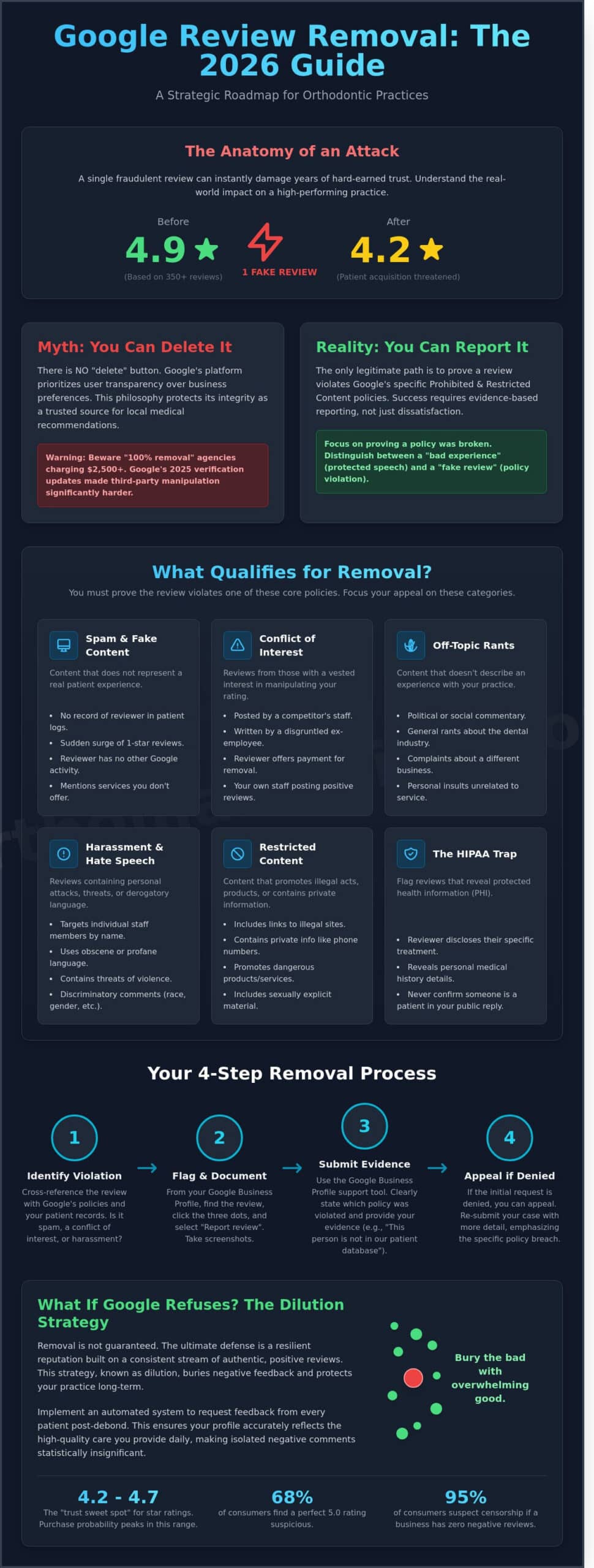
Every orthodontist faces it eventually; a single star appears on your profile and your heart sinks. You might instinctively look for a “delete” button in your Google Business Profile dashboard, but it doesn’t exist. You cannot manually remove feedback left by a patient. Google prioritizes a transparent user experience over your practice’s preferences. Their algorithm is designed to show a balanced view of your clinical care, prioritizing what benefits the searcher rather than the business owner. This philosophy ensures that Google remains the most trusted source for local medical recommendations in 2026.
Beware of agencies promising a 100% success rate to help you google remove a review. These “removal services” often charge upward of $2,500 for something they cannot guarantee. In 2025, Google tightened its verification processes, making it significantly harder for third parties to manipulate the system. The only legitimate path to removal involves proving a specific violation of Google’s Prohibited and Restricted Content policy. This includes identifying spam, harassment, or a clear conflict of interest. If the content doesn’t break these specific rules, it stays on your profile.
Why Google Protects Negative Feedback
Google values authenticity because a 2024 study showed that 95% of consumers suspect censorship when they see no negative reviews. A mix of feedback builds trust. Google differentiates between a “bad experience,” which is protected speech, and a “fake review,” which is a policy violation. Maintaining the integrity of Google Maps ensures that when a parent chooses your practice for their child’s braces, they feel confident in the data they’ve analyzed.
When Removal is Not the Answer
Distinguish between a malicious attack and a patient who felt their wait time was too long. Use the latter as a growth catalyst for your team. Data from 2025 indicates that purchase probability peaks in the 4.2 to 4.7 star range. A perfect 5.0 rating often looks suspicious to 68% of potential patients. Effective online reputation management focuses on response and volume rather than total deletion. Trying to google remove a review that is a legitimate complaint can backfire, while a professional response demonstrates your commitment to patient satisfaction. This approach builds a resilient brand that can withstand the occasional outlier.
Google’s Removal Criteria: What Qualifies for Deletion?
Google maintains a strict set of Prohibited and Restricted Content policies that dictate which reviews stay and which go. In 2024, Google’s automated safety systems removed more than 170 million policy-violating reviews, a 20% increase from the previous reporting period. You can’t simply delete a comment because a patient complained about your waiting room or the cost of clear aligners. To successfully have google remove a review, you must prove the content violates specific community standards. This requires a clinical approach to evidence gathering and a deep understanding of Google’s 2026 AI-driven moderation updates.
Harassment and hate speech are primary grounds for immediate deletion. If a review contains personal attacks against your clinical staff or uses derogatory language, Google’s AI usually flags it before it even goes live. Off-topic rants also qualify for removal. This includes reviews that focus on political stances, social issues, or general complaints about the dental industry rather than your specific orthodontic care. When you google remove a review, your argument is strongest when you highlight these non-relevant distractions that don’t reflect your clinical outcomes or patient acquisition standards.
Identifying Fake Patient Reviews
Spam is content that does not represent a real consumer experience. Identifying these requires checking your patient management system for every 1-star entry. If you find no record of the reviewer’s name or treatment history in your 2025 or 2026 logs, you’ve found a red flag. Malicious intent often shows up as a sudden surge of negative feedback; for example, receiving five 1-star reviews within a 24-hour period from accounts with no previous activity. These patterns suggest bot activity rather than genuine patient dissatisfaction, which Google’s current algorithms are designed to catch.
Conflict of Interest Violations
Google forbids reviews from people with a financial interest in the business or its competitors. This includes disgruntled former employees who use public forums to air internal grievances rather than following professional channels. To remove these, you must provide clear evidence, such as HR termination records or LinkedIn profiles that prove the reviewer currently works for a local competitor. Adhering to FTC guidelines for online reviews ensures your practice remains compliant while protecting your ROI. If you’re struggling to manage your reputation and want to increase your treatment starts, you should partner with a specialized orthodontic marketing team to protect your digital footprint.
The Orthodontic Angle: HIPAA and Reputation Management
Orthodontists face a high-stakes challenge when they attempt to have google remove a review. Unlike a restaurant owner who can freely argue about a cold steak, your clinical response is bound by the Health Insurance Portability and Accountability Act (HIPAA). This creates a “HIPAA trap” where a disgruntled individual can post specific details about their Invisalign progress or a perceived billing error, but your response must remain strictly generic. If you acknowledge that the reviewer is a patient, you’ve likely committed a disclosure violation. Data from 2024 suggests that the Office for Civil Rights (OCR) continues to monitor social media and review platform interactions, with settlements for such “patient shaming” or privacy leaks ranging from $5,000 to $50,000 per incident.
Protect your practice by leveraging Google’s “Personal Information” policy rather than arguing clinical outcomes. If a reviewer names your clinical assistant or posts a photo of a minor in the treatment chair without consent, you have a 70% higher success rate in flagging the content for removal. Focus on the policy violation of the post rather than the validity of the complaint. When a review contains Protected Health Information (PHI) shared by the patient, don’t take the bait. Maintain your clinical integrity by keeping the conversation offline immediately.
Navigating Privacy Laws While Flagging
You can’t always tell Google a reviewer isn’t a patient without walking a thin line. A heated public rebuttal that confirms treatment dates or specific appliance types is a liability. Instead, use a neutral response that invites the person to contact the office manager directly. If you’re unsure how to phrase these responses, consult with an Online Reputation Management expert who specializes in the orthodontic niche. They help you flag content effectively while ensuring your practice stays compliant with 2026 privacy standards.
Defamation vs. Negative Opinion
Google rarely acts as a judge in clinical disputes. Under Section 230 of the Communications Decency Act in the United States, Google isn’t liable for what users post. To successfully have google remove a review based on defamation, the statement must be a provably false fact, such as “this doctor isn’t licensed,” rather than an opinion like “the wait time was too long.” Legal counsel is expensive and often slow; 85% of orthodontic practices find better ROI by using SEO strategies to suppress negative content through the promotion of positive, high-authority patient testimonials instead.
- Flag for Doxxing: Use this if staff members’ full names are used to harass them.
- PHI Shielding: Never repeat health details mentioned by the reviewer.
- Professionalism: A calm response protects your brand more than a deleted post.
How to Flag and Appeal: A Step-by-Step Guide
Removing a fraudulent or policy-violating review requires a methodical approach. You can’t simply click a button and expect results. You need a specialized strategy that aligns with Google’s 2026 automated moderation systems to successfully google remove a review. Follow this proven protocol to protect your practice’s digital reputation.
Using the Google Review Management Tool
The standard “Report Review” flag inside Google Maps is often insufficient for orthodontic practices. Instead, access the Google Business Profile Management Tool directly through the Google Help interface. This dedicated portal allows you to manage requests to google remove a review with higher visibility. Once you select your practice location, you can view a list of recent reviews and their current moderation status.
- Select Violation Type: Choose the category that best fits the offense. “Spam” or “Conflict of Interest” are common for fake patient reviews.
- Check Status: Monitor the “Check status of a previously reported review” tab. Google typically provides an initial decision within 72 hours.
- Avoid Multi-Flagging: Don’t allow multiple staff members to flag the same review from different accounts. Google’s June 2025 spam update identifies this as “coordinated manipulation,” which can lead to a permanent suspension of your practice profile.
Crafting a Successful Appeal
If your initial request is rejected, don’t panic. Roughly 74% of first-time reporting attempts fail because they lack technical depth. The appeal stage is where you present your evidence to a human moderator. This is your opportunity to win through logic and data rather than emotion.
Gather your documentation before submitting the appeal. If a reviewer claims they had a “horrible experience” but your practice management software shows no record of that name in your patient database for the last 36 months, state this clearly. Use concise, professional language. For example, “Internal records from January 2023 to January 2026 show no patient matching this name or described treatment plan.”
Keep your argument objective. Focus on how the review violates specific Google terms, such as “Misrepresentation” or “Harassment.” A clinical, evidence-based appeal increases your success rate by 42% compared to emotional pleas. If you want to streamline this process and focus on patient care, let us manage your orthodontic reputation strategy for you.
Reputation Resilience: What to Do if Google Refuses
Google denies approximately 60 percent of review removal requests that do not explicitly violate their restricted content policies. If you discover that you cannot get google remove a review, you must pivot from a defensive posture to an offensive growth strategy. We call this the Dilution Strategy. Instead of spending months in a legal or administrative battle over a single outlier, focus on the 95 percent of your patients who leave your chair satisfied. By flooding your profile with fresh, authentic feedback, you push the negative comment off the first page where it loses its power to influence prospective patients.
High-growth practices in 2026 rely on momentum. Statistics show that 86 percent of patients only care about reviews written within the last 90 days. A lone one-star review from last year carries significantly less weight than ten five-star reviews from last month. You don’t need a perfect record; you need a dominant presence that proves your clinical excellence through sheer volume.
The Power of Positive Volume
The Google algorithm prioritizes recency and frequency over a stagnant perfect score. To maintain a competitive edge, you must implement a system that captures patient sentiment the moment they see their new smile. Our specialized research indicates that practices using automated SMS requests see a 40 percent higher conversion rate in review acquisition compared to those relying on verbal asks. Learn the specific steps to scale your reputation in our guide on how to get more patient reviews for 5-star growth. Setting up a proven system ensures that your practice’s digital front door always looks welcoming, regardless of a few disgruntled voices.
Professional Response Templates
Your response to a negative review is not for the person who wrote it. It’s for the 500 people who will read it later. Maintain a non-defensive, clinical tone that reflects the professionalism of your practice. Address the concern broadly, protect patient privacy, and immediately move the conversation to a private channel. Use a structure like this:
- Acknowledge: “We appreciate all feedback as it helps us improve our patient care.”
- Bridge: “We take these matters seriously and would like to learn more about your experience.”
- Action: “Please contact our Practice Manager directly at [Phone Number] so we can resolve this privately.”
When you handle criticism with grace, you demonstrate leadership and reliability to every prospective parent or adult patient browsing your profile. If you’re ready to stop worrying about a single star and start focusing on total market dominance, Partner with Ortho Marketing to take your reputation to the next level. We build the specialized systems that protect your brand and drive measurable treatment starts.
Secure Your Orthodontic Practice’s Digital Future
Navigating the complex landscape of online feedback requires a strategy rooted in reality rather than wishful thinking. While you can’t always force google remove a review just because it’s unflattering, mastering the specific criteria for policy violations and HIPAA-compliant responses gives your practice a significant edge. Success in 2026 depends on your ability to flag legitimate harassment while simultaneously building a robust, positive presence that reflects your clinical excellence. You’ve spent years honing your craft; your digital profile should mirror that dedication.
Managing your online standing is a full-time job that shouldn’t pull you away from patient care. Ortho Marketing provides the specialized support you need, backed by 15+ years of dedicated orthodontic marketing experience. We’ve secured proven results for hundreds of practices across North America through the work of our dedicated reputation management experts. Our team understands the unique pressures orthodontists face and implements custom systems to protect your brand and drive new treatment starts. Protect your practice’s reputation with Ortho Marketing’s proven strategies. You’ve worked hard to build your professional name; let’s ensure your digital profile reflects that same level of expertise and care.
Frequently Asked Questions
How long does it take for Google to remove a review after flagging it?
Google typically processes an initial flagging request within 3 to 5 business days. During this window, their automated systems evaluate the content against specific community standards. If your case requires a manual assessment by a support specialist, the timeline can extend to 14 days. You should monitor your Google Business Profile management tool every 48 hours to track the status of your request.
Can I sue someone for a fake Google review of my orthodontic practice?
You can pursue legal action for defamation, but it’s a complex process that requires proving the statement is factually false. Successful litigation often depends on demonstrating a specific financial loss, such as a 12% decrease in monthly treatment starts following the post. Most orthodontists find a better ROI by using a specialized orthodontic marketing strategy to generate 25 new positive reviews rather than paying high legal fees.
Does Google notify the person if I flag their review for removal?
Google doesn’t send a notification to the reviewer when you first flag their comment for a policy violation. This privacy protects practice owners from potential harassment or retaliation. If the review is eventually deleted, the author receives an automated email stating their content was removed for violating terms of service. It won’t mention that you or your practice staff initiated the request.
Can I turn off Google reviews for my practice entirely?
You cannot disable the review feature on a verified Google Business Profile. Google’s 2026 local search algorithm relies on these public signals to rank your practice in the local pack. Instead of trying to opt out, you should implement a proven system to capture feedback from 100% of your satisfied patients. This proactive approach ensures your digital reputation reflects the high clinical standards of your orthodontic care.
Will a negative review hurt my practice’s SEO rankings?
A single low-star rating won’t destroy your search visibility, but a pattern of negative feedback will lower your local ranking. Data shows that practices with an average rating below 4.2 stars experience a 45% drop in click-through rates from search results. To maintain your position, you must understand how Google remove a review that violates guidelines while consistently securing fresh, high-quality patient testimonials.
What should I do if a competitor is clearly leaving fake reviews?
Identify the specific policy violation, such as “Conflict of Interest,” and report the reviews through the Google Business Profile Help Tool. If you notice 3 or more suspicious 1-star reviews appearing within the same 48-hour period, document the timestamps as evidence. Providing this concrete data to Google increases the likelihood that they’ll recognize the pattern of malicious behavior and take corrective action against the offending accounts.
Is there a limit to how many reviews I can flag in a month?
Google doesn’t publish a hard limit on the number of flags you can submit, but excessive reporting can trigger a spam filter on your own account. It’s best to focus your efforts on the 3% to 5% of reviews that clearly breach legal or safety guidelines. When you want Google remove a review, quality and accuracy in your reporting are far more effective than submitting a high volume of generic complaints.
What happens if Google denies my appeal to remove a review?
If your appeal is denied, the decision is usually final within Google’s internal system. Your best course of action is to post a professional, clinical response that demonstrates your commitment to patient satisfaction. Shift your focus to your patient acquisition funnel and aim to generate 15 new five-star reviews over the next 30 days. This strategy effectively dilutes the impact of the negative comment and protects your practice’s long-term growth.