

Pay-Per-Click (PPC) Advertising for Orthodontists: The 2026 Patient Acquisition Guide
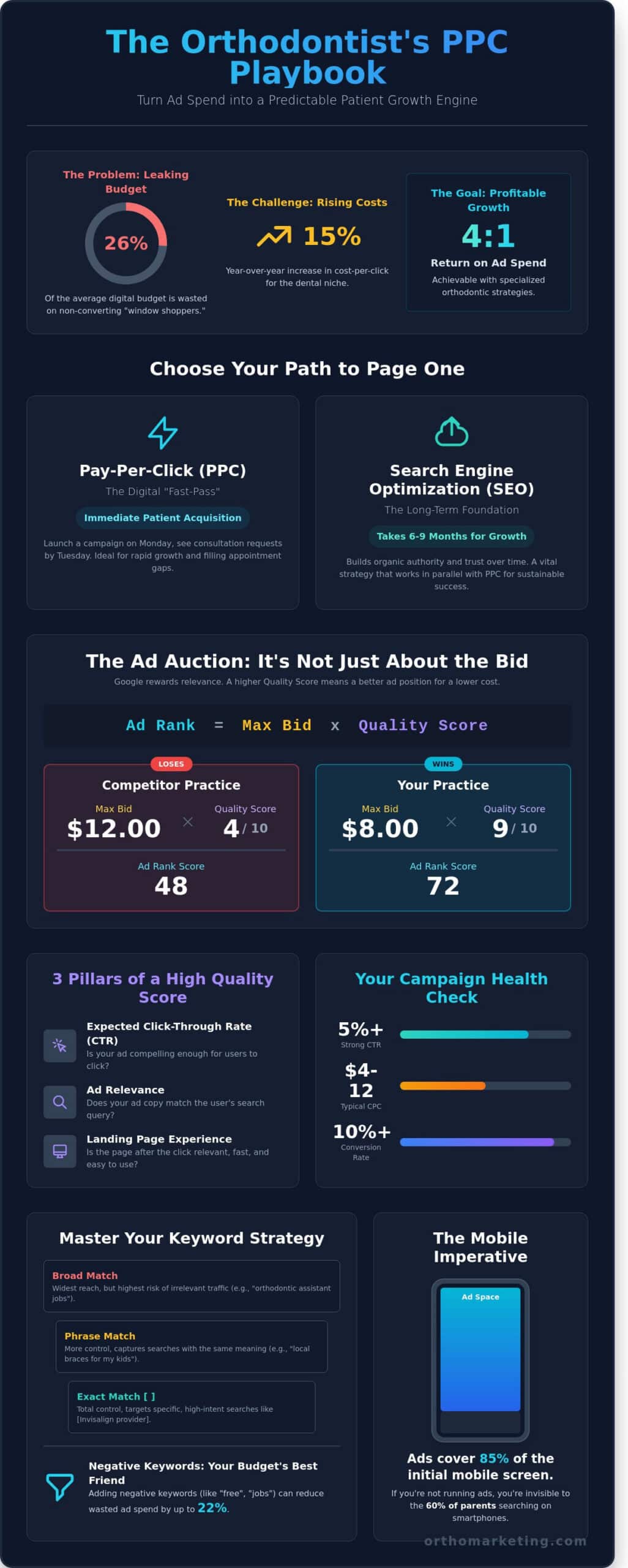
If your practice is like the average orthodontic clinic in 2024, you’re likely wasting 26% of your digital budget on window shoppers who never book an initial consultation. Mastering Pay-Per-Click Advertising isn’t just about spending more; it’s about outsmarting the high cost-per-click rates that have climbed 15% year-over-year in the dental niche. You’ve probably felt the sting of paying for clicks that don’t convert into actual treatment starts, leaving you questioning if digital growth is even sustainable for your local market.
We understand that you’re looking for clinical precision in your marketing, not just vague metrics. You deserve a system that provides clear visibility into which ads drive revenue and which ones just drain your bank account. This 2026 patient acquisition guide will show you how to capture high-intent patients and achieve a 4:1 return on ad spend by leveraging specialized orthodontic strategies. We’ll break down the exact campaign structures and tracking protocols needed to turn your ad account into a predictable growth engine for your practice.
Key Takeaways
- Understand how to leverage the digital “fast-pass” to the top of search results for immediate visibility and rapid patient acquisition.
- Learn to master the ad auction by focusing on relevance and Quality Score to reduce your costs while outperforming local competitors.
- Identify the strategic balance between capturing high-intent searchers on Google and driving visual brand awareness through Meta Ads.
- Discover the blueprint for building high-converting landing pages that transform digital traffic into measurable orthodontic treatment starts.
- See why specialized Pay-Per-Click Advertising strategies tailored to the orthodontic industry deliver a superior ROI compared to generalist marketing approaches.
What is Pay-Per-Click Advertising for Orthodontists?
Pay-Per-Click Advertising is a precise digital marketing model where your orthodontic practice only pays when a potential patient clicks on your advertisement. Unlike traditional billboards or print ads where you pay for impressions regardless of engagement, Pay-per-click (PPC) ensures your budget is spent only on active interest. It’s the most direct method to place your clinical expertise in front of local families who are actively seeking orthodontic care.
Think of PPC as a fast-pass to the top of the search engine results pages (SERPs). While Search Engine Optimization (SEO) is a vital long-term strategy that typically requires 6 to 9 months to show substantial organic growth, Pay-Per-Click Advertising provides immediate patient acquisition. You can launch a targeted campaign on Monday and begin receiving consultation requests by Tuesday morning. We primarily utilize three powerhouse platforms to drive these results: Google Ads for high-intent search traffic, Meta Ads for visual storytelling on Facebook and Instagram, and Microsoft Advertising to reach the 15% of users on desktop environments like Bing.
The Role of PPC in a Modern Orthodontic Practice
Strategic ad campaigns bridge the growth gap when opening a new location or during seasonal lulls in July and August. They allow your practice to target high-value keywords, such as “clear aligners” or “Invisalign for teens,” which often carry an organic competition score of 70 or higher. On mobile devices, ads dominate 85% of the initial screen space. If you aren’t running ads, you’re effectively invisible to the 60% of parents who search for providers exclusively on their smartphones.
Common PPC Terminology for Dental Professionals
- CTR (Click-Through Rate): This metric measures how many people clicked your ad compared to how many saw it. A 5% CTR is a strong indicator that your messaging resonates with your local community.
- CPC (Cost-Per-Click): This is the price you pay for a single click. In the orthodontic industry, prices fluctuate based on local auction competition, often ranging from $4.00 to $12.00 per click.
- Conversion Rate: This is the ultimate health check for your campaign. It tracks the percentage of clicks that result in a scheduled consultation request. Successful practices aim to maintain a conversion rate of 10% or higher to ensure a robust return on investment.
How the PPC Auction Works: Winning the Right Patients
Winning at Pay-Per-Click Advertising isn’t about having the deepest pockets. Google uses a sophisticated auction system where Ad Rank determines your position on the search results page. This rank is a mathematical product of your maximum bid and your Quality Score. A practice bidding $8.00 with a high Quality Score can easily outrank a competitor bidding $12.00. This system rewards relevance over raw spending power. To maintain professional standards, your ads must follow the FTC guidelines for online advertising, ensuring all claims about treatment results are truthful and substantiated.
Quality Score depends on three primary factors: expected click-through rate, ad relevance, and landing page experience. If a parent searches for “braces for kids” and your ad leads to a general homepage rather than a pediatric-focused page, your score drops. High scores lead to lower costs per acquisition. You should also master keyword match types to control your spend. Broad match offers wide reach but often attracts irrelevant traffic. Phrase match triggers ads for searches that include your phrase’s meaning. Exact match gives you total control over specific high-value terms like [Invisalign provider].
Stop wasting budget on “free dental clinics” or “orthodontic assistant jobs” by using negative keywords. Adding these filters can reduce wasted spend by up to 22% in the first month of a campaign. By telling Google what you don’t want to show up for, you ensure your dollars are reserved for patients ready to start treatment.
Targeting High-Intent Orthodontic Keywords
Local intent is the lifeblood of your digital growth. Roughly 76% of people who search for something nearby on their smartphone visit a related business within 24 hours. You must target “near me” queries for braces and Invisalign to capture this immediate demand. Protect your practice name by bidding on your own branded keywords; otherwise, competitors might siphon off your patient base. Long-tail keywords are specific phrases like ‘Invisalign for teens cost’ that indicate high purchase intent.
The Importance of Ad Extensions
Ad extensions expand your digital footprint and improve click-through rates by 10% to 15%. Use location extensions to show your office address and its exact distance from the searcher. Call extensions are vital for mobile users, allowing them to click-to-call your front desk directly from the search result. Sitelink extensions should drive traffic to high-conversion pages like “Before and After” galleries or “Financing Options.” Request a specialized PPC evaluation to optimize these extensions for your specific market and take your practice to the next level.
Google Ads vs. Meta Ads: Choosing Your Practice Strategy
Successful orthodontic marketing requires a dual-threat approach. You cannot rely on a single platform if you want to scale your treatment starts in 2026. Integrating Pay-per-click (PPC) advertising into your growth plan allows you to capture active searchers while building a pipeline of future patients. Google Ads targets the bottom of the funnel where people need a solution immediately. Meta Ads targets the top of the funnel by creating a desire for a new smile before the patient even begins their search.
A balanced strategy typically allocates 65% of the budget to Google and 35% to Meta. This specific split ensures you secure high-intent leads while maintaining brand visibility in your local community. Sophisticated practices use this multi-channel method to stay top-of-mind during the typical 3 to 6-month decision-making window for orthodontic treatment.
Google Ads: The King of Direct Lead Generation
Google Ads excels at capturing high-intent traffic. When a parent searches for “emergency orthodontist” or “braces consultation,” they are ready to book. In 2025, internal data showed that Local Service Ads (LSAs) increased trust signals by 42% compared to standard text ads because of the Google Guaranteed badge. Maximize your Pay-Per-Click Advertising ROI by using localized geo-fencing within a 12-mile radius of your office. This prevents your budget from being exhausted by clicks from users outside your primary service area.
Meta Ads: Visual Storytelling for Smile Transformations
Meta platforms like Facebook and Instagram are built for visual impact. You aren’t waiting for a search; you’re disrupting the scroll with a compelling transformation. Use high-definition video testimonials and “the big reveal” moments to trigger emotional responses in your audience. Focus your targeting on parents aged 30 to 55 and adults interested in self-improvement or dental health.
- Deploy retargeting pixels to show ads to users who visited your website but didn’t book a consultation.
- Use 15-second Reels to showcase your office culture and clinical expertise.
- A/B test “before and after” carousels against single-image patient stories.
Retargeting campaigns on Meta often see a 2.8x higher conversion rate than cold audience targeting. It’s a proven system to keep your practice in front of prospects until they are ready to commit to a consultation. Start today to take your practice to the next level through these specialized channels.
Building a High-Converting Orthodontic PPC Campaign
Success in Pay-Per-Click Advertising requires more than just a generous budget; it demands a clinical approach to campaign architecture. You aren’t just buying clicks. You’re investing in a predictable pipeline for new patient starts. To ensure your practice sees a return on every dollar, follow this specialized five-step framework designed for the orthodontic industry.
- Define Clear Goals: Stop tracking “visibility” and start tracking revenue-driving actions. Whether you want 15 new Invisalign consultations or 10 metal brace starts this month, your campaign settings must reflect these specific outcomes.
- Design Dedicated Landing Pages: If your ad promises a $500 discount on clear aligners, your landing page should mirror that offer exactly. Never send paid traffic to your homepage where users can get lost.
- Craft Compelling Ad Copy: Highlight your Unique Value Proposition (UVP). Use phrases like “Diamond Plus Provider” or “Same-day starts available” to differentiate your practice from general dentists.
- Implement Robust Conversion Tracking: Use tools like Google Tag Manager to see exactly which keywords result in a phone call or a form submission. You can’t scale what you don’t measure.
- Continuously A/B Test: Small changes yield big results. A 2024 performance study showed that changing a button from “Submit” to “Claim My Free Consultation” can increase conversions by 18%.
The Secret to Landing Pages That Convert
Your landing page is your digital treatment coordinator. It must be focused, persuasive, and incredibly fast. Avoid the clutter of your main website by removing navigation menus that distract potential patients. Include social proof like 5-star Google reviews and high-quality before-and-after photos to build immediate trust. Your landing page must load in under 2.5 seconds to prevent ‘bounce’ and maximize ad spend. A mobile-optimized lead form with fewer than four fields will significantly lower your cost-per-lead.
HIPAA Compliance and Digital Advertising
Maintaining clinical marketing standards is non-negotiable. Your lead forms must use encrypted, HIPAA-compliant servers to protect patient privacy. Be cautious with retargeting; displaying ads to users based on specific medical conditions can violate the 1996 Privacy Rule. Instead, focus on interest-based targeting that keeps your practice top-of-mind without compromising sensitive data. Partnering with a specialized agency ensures your Pay-Per-Click Advertising remains compliant while driving measurable growth.
Ready to see your calendar filled with high-value consultations? Partner with our specialized orthodontic marketing team to build your high-converting campaign today.
Why Specialized Orthodontic PPC Management Wins
Hiring a generalist agency is a gamble that often results in a 30% higher cost-per-acquisition due to broad, irrelevant keyword targeting. Most generalist firms don’t distinguish between a patient seeking a routine cleaning and one ready for a $5,000 comprehensive orthodontic treatment plan. Ortho Marketing leverages 15 years of niche expertise to ensure your Pay-Per-Click Advertising budget targets high-intent keywords like “Invisalign specialist” rather than generic dental terms. We understand the specific nuances of the orthodontic patient journey.
We customize every campaign to fit your specific goals. If you’re aiming for 25% year-over-year growth, we scale aggressively on high-volume terms. If you prefer efficiency, we tighten the focus to maximize your current chair capacity. This specialized approach creates a powerful synergy between your paid ads, organic SEO, and digital brand. It ensures your practice remains the top choice in your local market without wasting budget on “emergency tooth extraction” searches.
Measuring What Matters: Beyond the Click
To succeed in 2026, you’ve got to look past vanity metrics. A high click-through rate means nothing if it doesn’t result in a signed contract. We focus on Treatment Starts as the ultimate KPI for success. Ortho Marketing provides transparent, real-time reporting that links your ad spend directly to revenue generated. You’ll see exactly which campaigns are filling your exam rooms and which aren’t.
Google’s AI-driven bidding tools offer automation, but they lack the clinical context of your practice. Our professional bid management adds a layer of human expertise that prevents the AI from overspending on low-quality traffic. We monitor your campaigns daily to ensure a higher ROI on every dollar. This precision prevents the “set it and forget it” mistakes common in generalist agencies.
Partnering for Long-Term Practice Growth
Transitioning from buying leads to building a predictable patient pipeline is the hallmark of a mature practice. You don’t just need more phone calls; you need a consistent flow of qualified patients who value your expertise. We act as a dedicated marketing partner to help you scale efficiently and confidently. By integrating your Pay-Per-Click Advertising with a broader brand strategy, we help you take your practice to the next level of profitability.
Future-Proof Your Practice with Strategic Patient Acquisition
Navigating the digital landscape of 2026 requires more than just a basic online presence. It demands a sophisticated approach to Pay-Per-Click Advertising that balances high-intent search visibility with the visual storytelling of social media platforms. You’ve seen how a structured auction strategy and a high-converting campaign funnel are essential for capturing the right leads at the right time. Success hinges on your ability to turn digital interest into tangible treatment starts.
Generalist agencies often overlook the specific clinical nuances that drive a patient’s decision to choose your practice. Ortho Marketing brings 15+ years of specialized orthodontic marketing experience to the table; providing data-driven strategies tailored specifically for practices across the US and Canada. Our proven systems remove the guesswork from your growth plan. Don’t let your competition claim the local market share that belongs to you.
Your practice is ready for the next level of success, and we’re excited to help you reach it with confidence.
Frequently Asked Questions
How much should an orthodontist spend on PPC advertising?
Most single-location practices should invest between $2,500 and $5,000 per month into their Pay-Per-Click Advertising budget. This allows you to compete for high-value keywords like “Invisalign near me” in competitive 15-mile radiuses. Data from 2025 shows that practices spending less than $1,500 often fail to reach the minimum 40% impression share needed to dominate their local market. Secure your market share now.
How long does it take to see results from a PPC campaign?
You’ll see your ads appear on search results within 24 hours of launching a campaign. While traffic is instant, the true optimization phase requires 90 days of data collection. During this 3-month window, we refine negative keyword lists and landing pages to increase your conversion rate by an average of 22%. Consistency is the key to building a predictable patient pipeline.
Is Google Ads better than Facebook Ads for orthodontists?
Google Ads typically outperforms Facebook for immediate treatment starts because it targets high-intent searchers. Statistics indicate that 74% of prospective patients use Google to find a local specialist when they’re ready to book. Facebook serves as a powerful secondary tool for visual awareness, especially for 35% of parents who browse social media for family health recommendations. Balance both for maximum reach.
What is a good cost-per-lead for orthodontic ads?
A healthy cost-per-lead for a specialized orthodontic campaign ranges from $45 to $85. In 2026, targeting competitive terms for adult clear aligners often results in a $75 lead cost, while traditional braces leads can be secured for $50. Monitor these metrics closely to ensure your cost-per-acquisition remains below 10% of your average case value. Track every dollar to maximize your growth.
Can I manage my own PPC campaigns as a practice owner?
You can manage your own account, but most orthodontists lose 35% of their budget to inefficient broad-match keywords. Professional Pay-Per-Click Advertising management ensures your budget targets patients ready for a consult. Expert oversight prevents common mistakes like bidding on “free dental school” searches, which saves the average practice $800 in wasted spend monthly. Focus on your clinical work and let experts handle the data.
What happens if I stop my PPC advertising?
Your lead volume will drop by approximately 60% immediately after pausing your campaigns. Unlike organic strategies, paid visibility is a tap that stops flowing the moment you cut the budget. Data from 2024 suggests that practices that pause ads for over 30 days see a 15% decline in their overall brand search volume. Maintain your momentum to keep your chairs full.
How do I know if my PPC ads are actually resulting in new patients?
You track success by integrating HIPAA-compliant conversion tracking with your practice management software. We measure “New Patient Consult” form submissions and track phone calls lasting over 60 seconds. This data-driven approach allows you to see exactly which $1.00 of spend results in a $5,000 treatment start. You’ll gain 100% transparency into how your marketing budget transforms into actual practice revenue.
Will PPC advertising help my organic SEO rankings?
Paid ads don’t directly boost your organic rankings, but they do increase your total search engine real estate. When you run ads, you capture 20% more clicks across your entire digital presence because your brand appears twice on page one. This dual-presence strategy builds the trust necessary to convert skeptical parents into loyal patients. Dominate the search results to grow your practice faster.