

TLDR
Search engine optimization helps dental and orthodontic practices appear in search results when prospective patients look for care online. SEO combines technical website improvements, local search visibility, patient-focused content, and reputation management to drive new patient discovery. Practices that invest in SEO attract more qualified inquiries, reduce reliance on paid advertising, and build trust through organic search visibility.
Table of contents
- Why SEO Matters for Dental and Orthodontic Practices
- SEO Fundamentals in a Dental Practice Context
- Technical SEO: The Foundation of Website Visibility
- On-Page Optimization for Dental and Orthodontic Services
- Local SEO: Dominating “Near Me” and Location-Based Searches
- Content Strategy and Authority Building for Patient Trust
- Link Building and Reputation Signals in Dental Search
- Key Considerations for Dental SEO Implementation
- Measuring SEO Performance and ROI for Patient Acquisition
- Summary
- FAQ
Why SEO Matters for Dental and Orthodontic Practices
Most prospective patients search online before contacting a dental or orthodontic practice. They use search engines to find providers nearby, research specific treatments, read reviews, and compare options. If your practice doesn’t appear in those search results, you lose the opportunity to connect with patients actively seeking your services.
Dental and orthodontic practices face unique SEO challenges that differ from other industries. Patients searching for a dentist or orthodontist typically use location-based queries like “dentist in Peekskill” or “orthodontist in [city],” making local search visibility critical. They also search for specific concerns: “how to straighten teeth,” “cost of dental implants,” or “treatment for crowded teeth.” These searches reflect a patient’s stage in the decision journey, from initial awareness to ready-to-book.
Generic SEO advice from general marketing agencies often misses these nuances, treating dental practices like any other business. Trust signals matter more in dental search than in many industries. Patients want to know about your credentials, experience, patient testimonials, and how long you’ve served your community. Search engines reward practices that build authority through quality content, positive reviews, and consistent online presence. Practices that understand this connection between SEO and patient psychology gain a competitive advantage in their local market.
SEO Fundamentals in a Dental Practice Context
SEO works through three interconnected pillars: technical optimization, on-page optimization, and off-page authority. Technical SEO ensures search engines can crawl and index your website efficiently. On-page SEO makes individual pages relevant to patient search queries and improves user experience. Off-page SEO builds your practice’s credibility through reviews, citations, and backlinks from trusted sources. Together, these pillars determine whether your practice ranks in search results and how visible you are to prospective patients.
For dental practices, this framework translates into specific actions. A technically sound website loads quickly on mobile devices, uses secure HTTPS encryption, and has clear navigation that helps both patients and search engines find information. On-page work involves optimizing service pages for keywords like “dental crowns” or “clear aligners,” writing content that answers patient questions, and structuring information so search engines understand what your practice offers. Off-page work includes earning positive reviews, maintaining consistent business information across directories, and building relationships with local organizations that link to your site.
Technical SEO: The Foundation of Website Visibility
Technical SEO creates the foundation that allows search engines to discover, crawl, and rank your website. Without solid technical fundamentals, even excellent content and strong reputation signals won’t help your practice rank well. Key technical elements include site speed, mobile responsiveness, HTTPS security, XML sitemaps, robots.txt files, and structured data markup.

Site speed directly affects both search rankings and patient experience. Patients expect websites to load in under three seconds; slower sites frustrate visitors and increase bounce rates. Search engines penalize slow sites in rankings because they prioritize user experience. Mobile responsiveness is equally critical because most patients search for dental providers on smartphones. Your website must display correctly and function smoothly on all device sizes.
HTTPS encryption protects patient data and signals trustworthiness to search engines. An SSL certificate (the “s” in HTTPS) encrypts information transmitted between a patient’s browser and your website, which is essential for any practice collecting contact information or appointment requests. XML sitemaps help search engines find all your pages, including service pages and location pages that might not be linked prominently in your navigation.
Robots.txt files tell search engines which pages to crawl and which to skip, preventing them from wasting time on duplicate or low-value pages. Structured data markup uses code to tell search engines exactly what information appears on your pages. For dental practices, this means marking up your business name, address, phone number, hours, services offered, and patient reviews in a format search engines understand.
This markup helps search engines display your practice information correctly in search results and local listings, making it easier for patients to find and contact you.
On-Page Optimization for Dental and Orthodontic Services
On-page optimization focuses on individual pages and how they communicate with both search engines and patients. It begins with keyword research to understand what terms prospective patients actually use when searching for your services. A patient searching for “how much do braces cost” has different intent than one searching for “orthodontist accepting new patients.” Effective keyword research identifies these variations and guides content strategy.
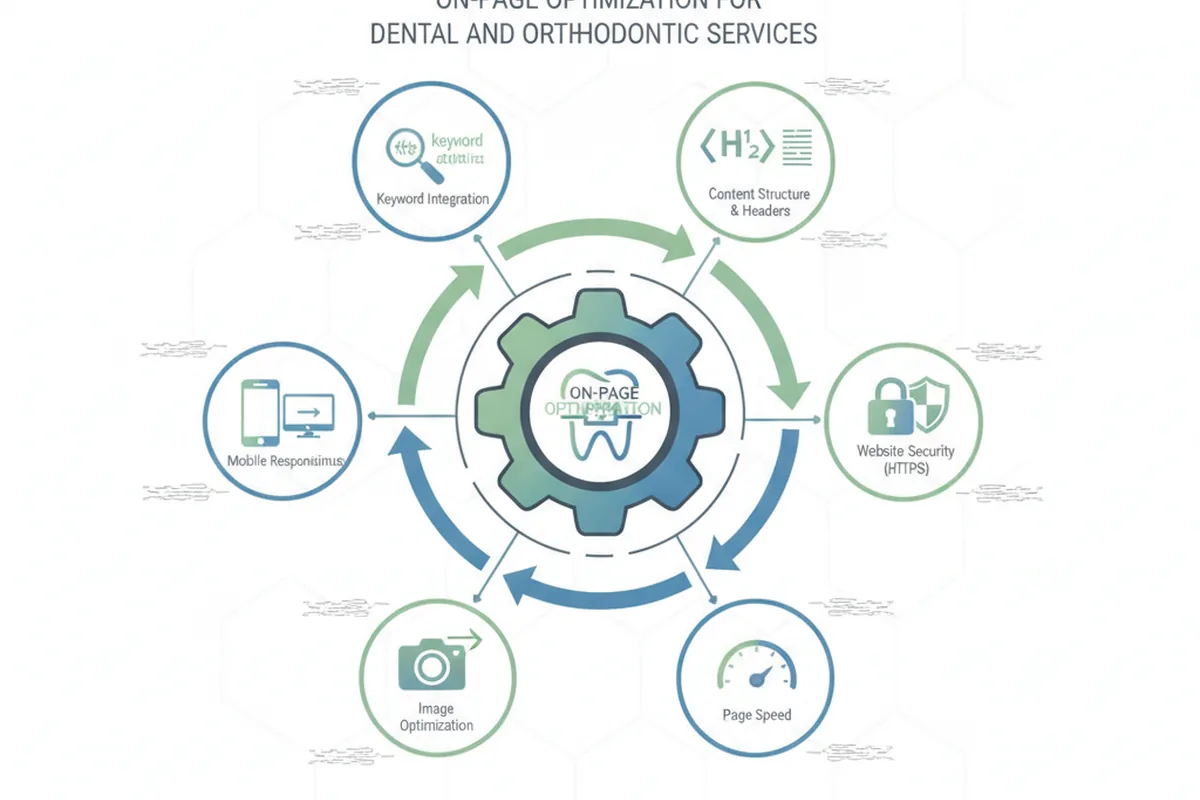
Page titles and meta descriptions are the first elements patients see in search results. A strong page title includes your service and location (for example, “Dental Implants in Peekskill, NY”) and clearly tells patients what they’ll find on the page. Meta descriptions summarize page content in 150-160 characters, encouraging clicks from search results. Both should be unique for each page and written for human readers first, search engines second.
Heading structure organizes content logically for both readers and search engines. Use one H1 per page (the main topic), then H2 and H3 headings to break content into digestible sections. This hierarchy helps patients scan your page quickly and helps search engines understand your content’s organization. Keyword placement matters, but only naturally. Avoid forcing keywords into headings or body text; instead, write for clarity and let keywords appear where they fit the topic.
Image optimization involves adding descriptive alt text that explains what images show. Alt text helps patients using screen readers and tells search engines what images contain. For before-and-after photos, a descriptive alt text like “patient smile before and after orthodontic treatment” is more helpful than generic labels. Calls-to-action should guide patients toward the next step, scheduling an appointment or requesting more information, without overwhelming the page with multiple competing buttons.
Local SEO: Dominating “Near Me” and Location-Based Searches
Local SEO addresses the dominant search pattern for dental patients: location-specific queries. When someone searches “dentist in Peekskill” or “orthodontist in [city],” they’re signaling immediate intent to find a local provider. Practices that optimize for local search capture these high-intent patients before competitors do.
Google My Business optimization is the foundation of local SEO. Your Google My Business profile appears in local search results, Google Maps, and the knowledge panel on the right side of search results. Claiming and optimizing your profile means ensuring your business name, address, phone number, hours, and services are accurate and complete. Adding high-quality photos of your practice, team, and patient results helps patients feel confident before their first visit.
Regularly posting updates and responding to patient reviews keeps your profile active and signals to Google that your practice is engaged.
Local citation consistency means your practice information (name, address, phone number) must be identical across all online directories, review sites, and local listings. Inconsistencies confuse search engines and reduce your local ranking. Audit your presence on Google, Yelp, Healthgrades, ZocDoc, and industry-specific directories to ensure NAP accuracy. For multi-location practices, create separate pages and profiles for each location, each with location-specific keywords and content.
Localized keyword targeting involves using city and neighborhood names in your content and keywords. Rather than just “dental cleaning,” target “dental cleaning in Peekskill” or “teeth cleaning near downtown.” Location pages for multi-location practices should include neighborhood-specific information, local landmarks, and community details that help patients feel connected to your practice. Local schema markup tells search engines your practice’s location, hours, and services, improving how your information displays in local results.
Patient reviews and ratings significantly influence local rankings and patient choice. Practices with more reviews and higher ratings rank better in local search and attract more inquiries. Encourage satisfied patients to leave reviews on Google, Yelp, and other platforms. Respond professionally to all reviews—both positive and negative—to show you value patient feedback and are committed to service quality.
Content Strategy and Authority Building for Patient Trust
Content strategy moves beyond optimizing existing pages to creating new resources that answer patient questions and establish your practice as a trusted authority. Blog posts, service guides, and educational resources serve dual purposes: they attract search traffic and build patient confidence in your expertise.
Keyword-aligned content planning starts with understanding what questions patients ask at each stage of their journey. Early-stage patients might search “what is an orthodontic consultation” or “signs you need braces.” Mid-stage patients search “how long do braces take” or “cost of clear aligners.” Late-stage patients search “orthodontist in Peekskill” or “schedule appointment.” Creating content for each stage captures patients across the entire decision journey.
Topic clustering establishes topical authority by grouping related content around core themes. Instead of writing isolated blog posts, create a pillar page on a broad topic (for example, “Complete Guide to Orthodontic Treatment”) and then write cluster content that explores specific subtopics (Types of Braces, Orthodontic Treatment Timeline, Caring for Your Braces). This structure signals to search engines that your practice has deep expertise in orthodontics, improving rankings for related keywords.
Answering patient questions directly builds trust and captures search traffic. Common questions include “Is orthodontic treatment uncomfortable?” “How much do braces cost?” and “Can adults get braces?” Create content that honestly addresses these concerns, explaining what patients can expect and how your practice approaches treatment. Avoid overpromising; instead, explain typical experiences and encourage patients to discuss their specific situation during a consultation.
Credential signals reinforce your authority. Include information about your education, certifications, years of practice experience, and professional memberships. Feature your team members with their credentials and specialties. Patient testimonials and case studies show real results and build confidence. Video conten, whether practice tours, patient testimonials, or educational explanations—increases engagement and time on page, both of which signal quality to search engines.
Link Building and Reputation Signals in Dental Search
External links from other websites act as votes of confidence in your practice’s authority. Search engines interpret links as endorsements, especially when they come from trusted, relevant sources. High-quality backlinks improve your rankings and drive referral traffic from other websites.
Earning backlinks happens through genuine relationships and valuable content. Partner with local organizations, schools, and community groups that might link to your practice. Create content so useful that other websites naturally want to link to it—for example, a comprehensive guide to orthodontic treatment or a resource for parents. Avoid link schemes or paying for links, which violate search engine guidelines and can result in penalties.
Online reviews function as both reputation signals and conversion tools. Patients read reviews before choosing a practice, and search engines use review volume and ratings as ranking factors. Practices with more positive reviews rank higher in local search and attract more inquiries. Encourage satisfied patients to leave reviews by making the process easy—send follow-up emails with direct links to review platforms, mention reviews during appointments, and thank patients who take time to share feedback.
Responding to reviews professionally demonstrates your commitment to patient satisfaction. Reply to positive reviews with gratitude and personalization. Address negative reviews calmly and professionally, offering to resolve concerns offline. This engagement shows potential patients that you take feedback seriously and care about patient experience.
Reputation management integrates with SEO strategy by building a consistent, positive online presence. Monitor what patients say about your practice across Google, Yelp, Facebook, and industry-specific sites. Respond promptly to inquiries and reviews. Share patient success stories and educational content on social media. This ongoing engagement builds trust and signals to search engines that your practice is active and engaged with its community.
Key Considerations for Dental SEO Implementation
Implementing SEO requires realistic expectations about timeline, resources, and outcomes. SEO is a long-term investment; most practices see meaningful results within three to six months, with continued improvement over time. Search rankings don’t change overnight, but consistent effort compounds into sustainable growth.
Prioritizing SEO tactics depends on your practice stage and budget. A startup practice should focus on technical foundations, Google My Business optimization, and local citations before investing heavily in content creation. An established practice with strong local presence might prioritize content strategy and link building to expand reach. A practice with limited budget should focus on high-impact, low-cost tactics like review generation and local optimization before considering paid advertising.
Deciding between in-house SEO and outsourcing depends on your team’s expertise and available time. SEO requires ongoing attention to technical updates, algorithm changes, and content strategy. Many practices find that outsourcing to a specialist agency with dental industry experience delivers better results than attempting SEO in-house without dedicated expertise. A specialist understands how patient search behavior, practice operations, and competitive positioning differ across geographic markets and practice types.
Common pitfalls include keyword stuffing (overusing keywords unnaturally), creating low-quality content just to rank, neglecting mobile optimization, and ignoring patient reviews. Avoid these mistakes by prioritizing genuine patient value over search engine manipulation. Write for humans first; search engines reward content that serves readers well.
Integrating SEO with your patient communication and appointment systems ensures that SEO traffic converts into actual appointments. Make sure your website’s contact forms work smoothly, your phone number is easy to find, and your appointment scheduling system is user-friendly. Track which keywords and pages drive the most inquiries and appointments so you can double down on what works.
To support your SEO foundation, explore resources on strategy and implementation. Visit Orthodontic Agency Practice to learn about comprehensive solutions, review guidance on Seo Essential Investment, and understand how to approach Seo Company Orthodontists. You may also benefit from exploring Crm Tools Orthodontic, and reviewing Essential Tips Orthodontic.
Measuring SEO Performance and ROI for Patient Acquisition
Measuring SEO success requires tracking metrics that connect search visibility to business outcomes. Organic search traffic shows how many patients find your website through search engines. Keyword rankings indicate which search terms your practice appears for and at what position. These metrics matter, but they’re only meaningful if they drive actual patient inquiries and appointments.
Conversion metrics tie SEO effort to business results. Track how many website visitors request an appointment, call your practice, or submit a contact form. Monitor how many of these inquiries convert into new patient appointments. Calculate the average value of a new patient to understand your SEO return on investment.
Set realistic expectations for SEO ROI timeline. Most practices see initial results within three months, but significant growth typically takes six to twelve months. Local SEO often shows faster results than broader keyword targeting. Competitive markets may require longer investment before ranking for high-value keywords. Discuss realistic timelines with your SEO partner based on your market, competition, and current website foundation.
Conduct regular performance reviews to identify gaps and opportunities. Monthly reviews of traffic, rankings, and conversions help you spot trends and adjust strategy. Quarterly reviews should examine broader patterns: which service pages attract the most traffic, which keywords drive the most appointments, which content performs best. Use this data to allocate resources toward high-performing areas and improve underperforming sections.
Use data to adjust strategy over time. If certain keywords drive more qualified inquiries than others, create more content around those topics. If specific service pages convert better than others, apply those design and messaging principles to other pages. If reviews significantly influence patient choice in your market, invest more in review generation. SEO is not a set-it-and-forget-it strategy; it’s an ongoing process of measurement, learning, and optimization.
Summary
SEO Strategies to Attract New Dental and Orthodontic Patients combine technical website optimization, local search visibility, patient-focused content, and reputation management into a cohesive patient discovery system. Practices that invest in SEO appear in search results when prospective patients look for care, build trust through authority and reviews, and convert more inquiries into appointments.
Unlike generic digital marketing approaches, effective dental SEO addresses the specific patient search patterns, trust requirements, and competitive dynamics of dental practice markets. Success requires realistic timelines, consistent effort, and willingness to measure results and adjust strategy based on data. Whether you manage SEO in-house or partner with a specialist agency, prioritizing SEO as a core patient acquisition strategy delivers sustainable practice growth.
Oral health recommendations from the American Dental Association emphasize the importance of regular dental care and patient education. When your practice appears in search results and builds trust through quality content and positive reviews, you help prospective patients find the care they need.
Educational note: This article is a general guide to SEO strategy for dental and orthodontic practices. It does not replace individualized advice for your specific practice, market, or competitive situation. SEO results depend on consistent implementation, market conditions, and many factors beyond your control. Consult with a qualified SEO professional or marketing partner to develop a strategy tailored to your practice’s needs and goals.
FAQ
What is the difference between SEO and paid search advertising for dental practices?
SEO focuses on earning organic search rankings through website optimization and authority building, while paid search (PPC) involves paying for ads that appear at the top of search results. SEO takes longer to show results but builds sustainable, long-term visibility and typically costs less over time. Paid search delivers immediate visibility but requires ongoing budget. Most practices benefit from combining both strategies.
How long does it take to see results from dental SEO?
Most practices see initial improvements in search visibility within three to six months, with more significant results appearing after six to twelve months. Local SEO often shows faster results than broader keyword targeting. Timeline depends on your market’s competitiveness, your website’s current foundation, and how consistently you implement SEO strategies. Discuss realistic expectations with your SEO partner based on your specific situation.
Why are online reviews important for dental SEO?
Online reviews influence both search rankings and patient choice. Practices with more positive reviews rank higher in local search results and attract more inquiries. Patients read reviews before choosing a provider, making review volume and ratings critical trust signals. Search engines use review data as a ranking factor, so actively encouraging and managing reviews directly supports your SEO performance.
Should my dental practice do SEO in-house or hire an agency?
This depends on your team’s expertise, available time, and budget. SEO requires ongoing attention to technical updates, algorithm changes, and content strategy. Many practices find that outsourcing to a specialist agency with dental industry experience delivers better results than attempting SEO without dedicated expertise. A specialist understands dental practice operations and patient psychology in ways general agencies do not.
How does Google My Business optimization affect my practice’s search visibility?
Google My Business is critical for local SEO. Your profile appears in local search results, Google Maps, and the knowledge panel on search results pages. Optimizing your profile with accurate information, photos, hours, and services improves your visibility to patients searching for local providers. Regularly updating your profile and responding to reviews keeps it active and signals engagement to Google.
What is the most important SEO factor for attracting new dental patients?
Local search visibility is typically the most important factor because most patients search for providers nearby. Optimizing your Google My Business profile, maintaining consistent business information across directories, and earning positive reviews directly drive local rankings. However, effective SEO requires all three pillars, technical, on-page, and off-page, to work together. No single factor alone supports success.


