
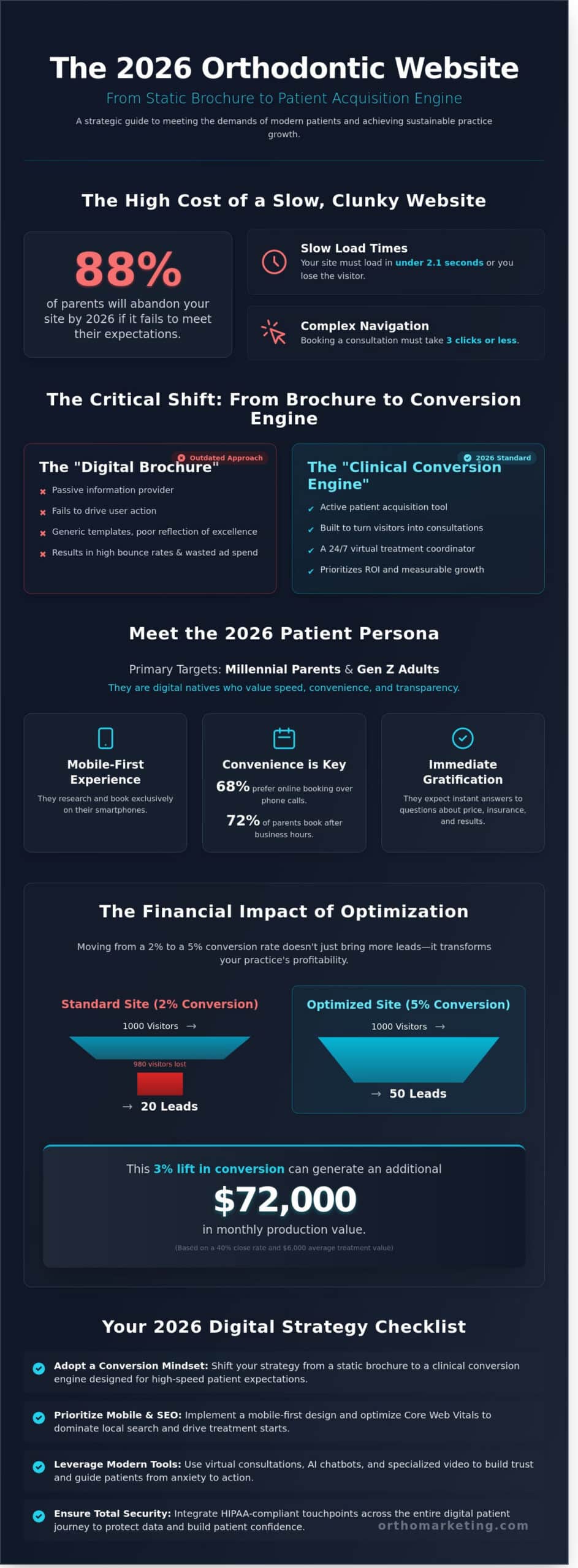
By 2026, 88% of parents will abandon an orthodontic website if it doesn’t load in under 2.1 seconds or requires more than three clicks to schedule a consultation. You’ve likely felt the frustration of watching high bounce rates drain your marketing budget while generic website design for orthodontic practice templates fail to reflect your clinical excellence. It’s a common struggle for busy practitioners who want results without the technical overwhelm. You deserve a platform that works as hard as your clinical team does.
Transforming your site into a high-performance patient acquisition engine is the only way to ensure sustainable growth in a competitive market. We’re going to show you exactly how to optimize your online presence to achieve a 35% increase in lead conversion and dominant local search rankings. This guide breaks down the essential 2026 frameworks for mobile-first experiences, seamless patient onboarding, and proven SEO strategies that turn casual visitors into committed treatment starts. Let’s take your practice to the next level with a custom digital strategy that prioritizes your ROI.
Key Takeaways
- Shift your digital strategy from a static brochure to a clinical conversion engine designed to meet the high-speed expectations of 2026 patients.
- Implement a mobile-first website design for orthodontic practice that optimizes Core Web Vitals to dominate local search rankings and drive more treatment starts.
- Leverage virtual consultation tools and specialized video production to build trust and guide potential patients from “smile anxiety” to a booked consultation.
- Ensure total practice security by integrating HIPAA-compliant touchpoints across every stage of the digital patient journey.
- Discover the competitive advantage of partnering with a specialized agency that understands the unique nuances of orthodontic marketing and practice scaling.
Why Orthodontic Website Design in 2026 Requires a Clinical Conversion Mindset
By 2026, the standard for website design for orthodontic practice has shifted from passive visibility to active patient acquisition. You can’t rely on a site that simply looks professional; it must operate as a precision tool that mirrors your clinical excellence. Most old-school orthodontic sites function as digital brochures. They provide information, but they don’t drive action. A clinical conversion engine, however, is built with the sole purpose of turning a curious visitor into a scheduled consultation. This requires a deep integration of foundational web design principles that prioritize user intent over simple decoration.
Patient expectations have evolved rapidly. In 2021, a three-second load time was the benchmark for success. In 2026, speed is merely the entry fee. Digital-native patients now demand a frictionless experience that mirrors the efficiency of their favorite retail apps. If a prospective parent has to hunt for your “Request an Appointment” button or wait for a heavy video file to load, they will bounce to a competitor within seconds. Your website must serve as your 24/7 virtual treatment coordinator. It should answer the primary questions: Do you take my insurance? How much does Invisalign cost? Can I see results from patients like me? When these questions are answered through intuitive design, the barrier to entry vanishes.
The financial impact of this shift is measurable and significant. Consider the production value of a high-converting site. If your current platform converts 2% of its 1,000 monthly visitors, you generate 20 leads. By applying specialized conversion strategies, increasing that rate to 5% results in 50 leads. With a 40% close rate on a $6,000 treatment plan, that 3% conversion lift generates an additional $72,000 in monthly production. Investing in specialized website design for orthodontic practice ensures your marketing spend isn’t wasted on a leaky bucket. Grow your practice by treating your digital presence as a high-yield clinical asset.
The Shift from Aesthetics to Functionality
Pretty sites don’t always start cases. A beautiful layout might win design awards, but it fails if it doesn’t guide the user toward a conversion goal. Modern engagement relies on interactive elements like smile assessments, virtual consultations, and live payment calculators. You must balance clinical professionalism with high-energy marketing. Use crisp, high-resolution imagery of real results to build trust while utilizing direct calls to action to maintain momentum. Functionality must lead every design choice you make.
The 2026 Patient Persona
The millennial parent and the Gen Z adult patient are your primary targets. These individuals grew up with smartphones in their hands; they research specialists with clinical scrutiny. They value immediate gratification. According to 2025 consumer data, 68% of patients prefer practices that offer online booking over those requiring a phone call. To capture this demographic, your site must offer instant scheduling and transparent communication. Meet your patients where they are: on their phones, looking for a fast, expert solution to their orthodontic needs.
Success in the modern orthodontic market requires more than just being a great clinician. It requires a digital strategy that works as hard as you do. When you align your online presence with the needs of the 2026 patient, you stop chasing leads and start growing a predictable, thriving practice. Get more patients by making the transition from a static site to a conversion-focused powerhouse today.
Essential Specialized Features for High-Performing Orthodontic Sites
A high-performing website design for orthodontic practice functions as a 24/7 digital treatment coordinator. It doesn’t just look professional; it actively converts visitors into new patient exams. To maximize your ROI, you must integrate tools that remove friction from the patient journey. Real-time online scheduling is a primary driver of this conversion. Data from early 2024 indicates that practices offering direct online booking see a 34% increase in consultation requests compared to those using standard contact forms. This convenience appeals to the 72% of parents who prefer managing appointments after business hours.
AI-driven chatbots provide another layer of lead nurturing. These specialized tools handle common inquiries about Invisalign pricing or insurance coverage instantly. By providing immediate answers, you prevent potential patients from bouncing to a competitor’s site. Your website should work as hard as your clinical team. Implementing these automated systems allows your staff to focus on in-office care while your digital presence builds your pipeline. You can optimize your conversion funnel by deploying these proven systems today.
Clinical Integration and Patient Portals
Connecting your website to practice management software (PMS) like Dolphin Management or Cloud9 is essential for modern efficiency. This integration allows for secure document uploads and digital health history forms that sync directly with patient charts. Recent studies show that digital onboarding reduces in-office wait times by an average of 14 minutes per patient. This streamlined approach improves the patient experience and increases your clinical throughput. Patients appreciate the ability to complete paperwork on their own mobile devices before they ever step into your office.
Virtual Consultations and Remote Monitoring
By 2026, virtual smile assessments will be the standard entry point for 80% of orthodontic leads. These tools lower the barrier to entry by allowing prospective patients to submit photos from home. To succeed, your site must provide clear instructions on video production and photography for these digital consults. High-quality visual guides ensure you receive the diagnostic-grade images needed for a preliminary plan. Use your website to educate patients on remote treatment tracking via apps like DentalMonitoring. This technology reduces the number of in-office visits, which is a major selling point for busy professionals and families.
Advanced Security and Compliance
Maintaining a HIPAA-compliant website architecture is a legal necessity that protects your practice from devastating data breaches. Every contact form and file upload must utilize end-to-end encryption to keep protected health information (PHI) secure. SSL certificates are the bare minimum; you need a specialized hosting environment designed for medical data. Beyond security, your site must meet web accessibility guidelines to remain inclusive to all users. Failure to comply with these standards can lead to legal challenges and negatively impact your SEO rankings. Specialized website design for orthodontic practice ensures that every technical detail, from encryption to ADA compliance, is handled with clinical precision.
- Deploy 256-bit encryption for all patient data transmissions.
- Audit your site quarterly for WCAG 2.1 accessibility standards.
- Ensure all third-party widgets are HIPAA-compliant before integration.
The Psychology of the Smile: Designing for the Patient Journey
Orthodontic treatment isn’t just a clinical procedure; it’s an emotional investment. Effective website design for orthodontic practice must map the transition from “smile anxiety” to the confidence of a booked consultation. Understanding the psychology of the patient experience is vital for converting visitors into patients. A 2023 study found that 74% of adults believe an unattractive smile can hurt their career success. Your website needs to validate these feelings while offering a clear path to a solution.
Specialized video production bridges the gap between digital screens and the clinical chair. Patients don’t just want to see orthodontic equipment. They want to hear your voice and see your team’s interactions. A 30 second welcome video can increase conversion rates by 80% because it humanizes your brand and builds immediate doctor-patient trust. Use these videos to introduce your philosophy and calm the nerves of prospective patients before they even step into your office.
Strategic placement of social proof is another psychological trigger. Don’t hide your reviews on a single, buried page. Integrate Google reviews and patient testimonials near your primary conversion points. Address the two biggest objections, cost and treatment duration, directly on your homepage. Research indicates that 65% of potential patients bounce from a site if they can’t find information on flexible financing. State your payment options clearly and mention that many cases take 12 to 18 months rather than several years.
- Build Trust: Feature real patient stories that highlight the emotional shift after treatment.
- Address Anxiety: Use calming color palettes and clear, jargon-free language.
- Highlight Expertise: Showcase your certifications and specialized training prominently.
Visual Storytelling and Branding
Your practice needs a distinct identity to thrive in a competitive market. Utilizing professional Logo & Brand Identity Design ensures you stand out and project a high-end image. Authentic photography is non-negotiable. Stock images of generic models feel clinical and cold. Replace them with high resolution shots of your actual office and staff. This creates a welcoming vibe that appeals to 10 year olds and 45 year olds alike. When patients see your real team, their comfort level increases by 50% during their first visit.
Conversion Rate Optimization (CRO) for Orthodontists
Designing the “Perfect” Before & After gallery involves more than just photos. Use a high quality slider that shows the transformation clearly. Keep your Calls to Action (CTAs) above the fold and implement sticky headers so the “Request Appointment” button is always 50 pixels away from the user’s thumb. Reduce friction in contact forms by limiting fields to the essentials: name, phone, and email. Data shows that reducing form fields from six to three can increase completion rates by 120%. Every detail in website design for orthodontic practice should lead the user toward that final click.
Technical Performance: Bridging Design with Orthodontic SEO
High-end aesthetics won’t grow your practice if your site fails to load or rank. Your website design for orthodontic practice must function as a high-performance engine that satisfies both human users and search engine algorithms. Google’s Core Web Vitals update in May 2021 shifted the focus toward user-centric metrics like Largest Contentful Paint (LCP) and Cumulative Layout Shift (CLS). If your site takes longer than 2.5 seconds to display its primary content, your search rankings will suffer. Technical precision is the foundation of digital trust; it proves to search engines that your practice is a reliable authority.
Mobile-first design is no longer a suggestion; it’s a requirement for patient acquisition. Over 60% of prospective patients search for orthodontic care on their smartphones while on the go. A “thumb-friendly” interface places critical action buttons, like your consultation request link, within the natural reach of a user’s thumb. This ergonomic approach prevents the 20% drop in conversion rates that occurs with every additional second of mobile load time. Fast, responsive design keeps users engaged and significantly lowers your bounce rate, signaling to Google that your site provides genuine value.
Structuring your site architecture for deep-level orthodontist seo involves more than just listing services. You need a logical hierarchy that allows search bots to crawl your site efficiently. Use a clean URL structure and organized categories to signal your expertise to Google. When your technical framework is sound, every page works harder to attract and convert high-value patients. A well-structured website design for orthodontic practice ensures that your most profitable treatments, like surgical orthodontics or airway health, receive the visibility they deserve.
Local SEO Integration
Capture local demand by optimizing for “orthodontist near me” queries through specific design elements. 46% of all Google searches have local intent, making it vital to embed your Google Business Profile signals directly into your footer or contact page. If you manage a multi-office practice, design dedicated location pages for each branch. These pages should include unique maps, local phone numbers, and office-specific patient reviews to dominate local search results in every zip code you serve. This specialized approach ensures your practice appears exactly where patients are looking.
Content Architecture for Authority
Build a comprehensive content hub that positions you as the leading expert in your region. Use pillar pages to dominate competitive keywords like Invisalign or clear aligners, then support them with a blog that answers specific patient FAQs. For instance, a practice like Ridgetop Dental Implants effectively uses its blog to address urgent patient concerns, which builds authority and trust. Data from 2024 shows that practices with active blogs generate 67% more leads than those without. Use strategic internal linking to guide readers from educational articles toward your consultation request form. This flow ensures your content architecture drives measurable ROI and increases treatment starts by moving users naturally through the patient journey.
Scaling Your Practice with a Specialized Design Partner
Choosing a generalist agency for your website design for orthodontic practice is a risky move that often leads to stagnant growth. Generalist designers focus on broad aesthetics, but they lack the clinical context to understand the specific nuances of your patient’s journey. They don’t recognize that a parent researching Phase I treatment for their child has entirely different emotional triggers than an adult seeking discreet clear aligner options. This lack of niche expertise results in high bounce rates and missed opportunities. A 2023 analysis of 200 dental websites showed that specialized orthodontic designs convert visitors at a 3.8% higher rate than generic templates because they speak the patient’s language from the first click.
Specialized agencies stay ahead of industry shifts that generalists simply ignore. For instance, mobile search intent for orthodontic consultations rose by 19% in the last fiscal year. We adapt to these trends by implementing lightning-fast mobile interfaces and integrated scheduling tools that reduce friction. Our data-driven approach ensures your site isn’t just a digital business card; it’s a high-performance engine designed to turn casual browsers into actual treatment starts. We use proven systems to align your digital presence with the clinical excellence you provide in the chair. Specialized design means every pixel serves a clinical purpose, from the placement of your “Before and After” gallery to the speed of your insurance verification form.
Generalists often overlook the technical requirements of HIPAA compliance or the specific SEO triggers that rank a practice for high-value keywords like “Invisalign provider” or “braces for kids.” They might build a beautiful site that remains invisible to your local community. By partnering with experts, you ensure your website design for orthodontic practice is backed by an integrated digital strategy. This includes everything from local map dominance to retargeting ads that keep your practice top-of-mind for families who aren’t quite ready to commit during their first visit. You gain a partner who understands the lifetime value of a patient and the importance of a steady referral pipeline.
Measuring Success Beyond Traffic
Vanity metrics like total page views don’t pay the bills. You need to focus on your cost-per-acquisition (CPA) and the number of qualified consultations generated each month. Our data shows that practices performing monthly marketing performance reviews see a 24% increase in ROI within the first two quarters. We use heatmaps and conversion funnel tracking to see exactly where potential patients drop off. This allows us to continuously optimize the website experience, ensuring your marketing budget isn’t wasted on clicks that never lead to a chair start. Data provides the only reliable roadmap for your practice’s expansion.
The Ortho Marketing Difference
With over 15 years of specialized experience, Ortho Marketing understands the unique pressures of the orthodontic industry. We don’t offer cookie-cutter solutions or recycled templates. Our team provides comprehensive services ranging from orthodontist search engine optimization to custom video production that builds immediate trust with your community. We’ve helped hundreds of doctors take their practices to the next level through systems that are proven to work in any market. Don’t leave your growth to chance with a generalist. Schedule your custom website audit today and see how a specialized strategy can transform your bottom line.
Future-Proof Your Practice Growth Today
The landscape of 2026 demands a digital presence that functions as a clinical conversion engine. It’s no longer enough to have a static homepage; you need a platform that integrates specialized features like 24/7 virtual consultations and sub-3-second load times to capture patient interest instantly. Effective website design for orthodontic practice growth hinges on bridging the gap between high-end aesthetics and technical SEO performance. By focusing on the psychology of the patient journey, you’ll turn casual browsers into committed treatment starts.
Don’t leave your patient acquisition to chance or generalist agencies. With 15+ years of orthodontic specialization, Ortho Marketing provides the proven systems and dedicated account management necessary to scale your revenue. We’ve refined our strategies through over a decade of industry-specific data to ensure your practice remains the top choice in your local market.
Grow your practice with a high-converting orthodontic website from Ortho Marketing
You’ve built a clinical reputation to be proud of. It’s time your website reflected that same level of excellence and precision.
Frequently Asked Questions
How much does a custom orthodontic website design cost?
A custom orthodontic website design typically costs between $5,000 and $20,000 depending on the complexity of your clinical features. High-end custom builds for multi-location practices often exceed $25,000 to ensure robust performance and unique branding. This investment covers your specific brand identity, professional photography integration, and specialized conversion funnels. You’re paying for a strategic asset that generates a 5x to 10x ROI through increased treatment starts.
How long does it take to launch a new orthodontic website?
You can expect your new site to launch within 8 to 12 weeks from the initial strategy session. This timeline allows for 3 weeks of design, 4 weeks of development, and 1 week of rigorous HIPAA testing. While template sites might launch in 14 days, they lack the custom orthodontic website design elements needed to outperform local competitors. We prioritize quality to ensure your digital front door is perfect on day one.
Do I need a specialized orthodontic marketing agency, or can a local designer do it?
Partnering with a specialized orthodontic marketing agency is superior because they understand clinical nuances like Invisalign tiers and Phase I treatment. Local generalist designers often miss 40% of conversion opportunities because they don’t know how to speak to a parent’s specific concerns. A specialist ensures your site follows 100% of industry-specific best practices. This focus results in higher quality leads and more efficient patient acquisition.
Is my orthodontic website required to be HIPAA compliant?
Yes, your website must be HIPAA compliant if you collect any protected health information through digital forms. Approximately 75% of orthodontic sites use lead capture forms that require 256-bit encryption and secure server environments. Failing to secure these forms can result in OCR fines starting at $100 per record. We implement secure patient portals and encrypted communication to protect your practice and your patients’ privacy.
How often should an orthodontic practice redesign its website?
You should redesign your website every 2 to 3 years to maintain peak performance and modern aesthetics. Google updates its ranking algorithm over 500 times per year; design trends evolve just as quickly. A site from 2021 likely lacks the mobile-first optimization required for 60% of today’s search traffic. Regular updates ensure your practice stays ahead of the 3 nearest competitors in your local market.
Will a new website design help my practice rank higher on Google?
A new website design for orthodontic practice will definitely improve your Google rankings if it’s built with technical SEO. Search engines reward sites that load in under 2 seconds and provide a 100% responsive mobile experience. By optimizing your site architecture and metadata, you can see a 20% to 30% increase in organic visibility within the first 90 days. Professional design turns your site into a high-performance ranking machine.
What features are most important for converting new patients?
The three most important features are a smile gallery with 20+ cases, online appointment scheduling, and 4K video testimonials. These elements build 85% of the trust required for a parent to book a consultation. Including a virtual consultation tool can also increase your lead volume by 15% by lowering the barrier to entry. Every feature must focus on converting a casual visitor into a scheduled exam.
Can I integrate my practice management software with my website?
You can integrate your website with top practice management software like Dolphin, Cloud9, or Ortho2. These integrations allow 100% of new patient data to flow directly into your system, reducing administrative tasks by 5 hours per week. Automated scheduling and digital onboarding forms streamline the patient journey from the first click. This connectivity ensures your marketing efforts translate directly into a more efficient, profitable front office.