

The Ultimate Orthodontist Website Redesign Checklist for 2026
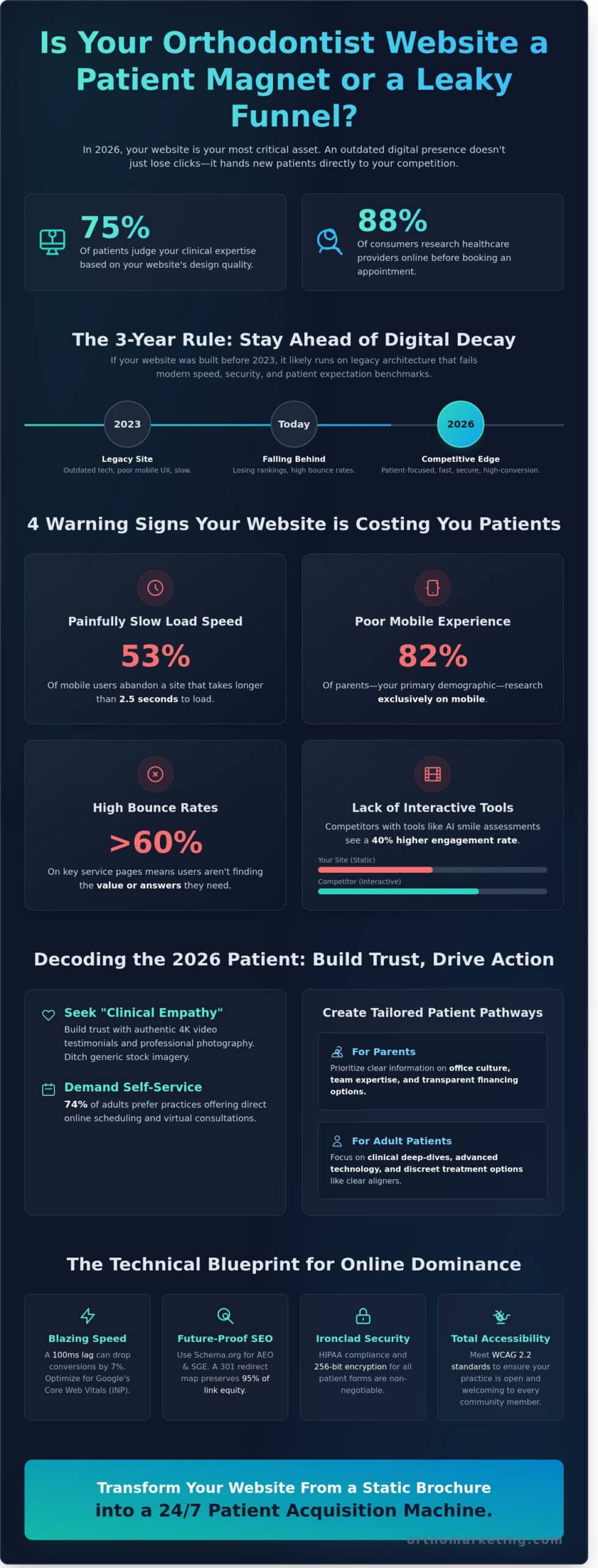
Did you know that 75% of prospective patients judge your clinical expertise based solely on the visual quality of your website? If your digital presence feels like a relic from 2018, you aren’t just losing clicks; you’re handing treatment starts to the competition. A strategic orthodontist website redesign is no longer optional if you want to capture the 88% of consumers who research providers online before booking. You’ve likely noticed that while your clinical results are world-class, your current site fails to reflect that same level of precision. It’s frustrating when high mobile bounce rates or a lack of online consultation requests hold your growth back.
We’ve developed this specialized guide to help you build a high-performance patient acquisition tool. You’ll discover the essential technical and aesthetic elements required to build immediate trust with parents and adult patients alike. From ensuring your site loads in under 2 seconds to achieving seamless integration with your patient management software, we’re providing the proven 2026 checklist to take your practice to the next level. We will cover the specific SEO strategies and conversion-focused design shifts that transform a static homepage into a results-driven digital asset.
Key Takeaways
- Learn why the “Three-Year Rule” is critical for keeping your practice ahead of rapid shifts in dental technology and patient expectations.
- Discover how to optimize your technical foundation to improve search rankings and protect your existing digital equity.
- Follow a comprehensive orthodontist website redesign checklist to transition your site into a high-performing, patient-generating machine.
- Identify the design elements that create a “Golden Path,” guiding visitors seamlessly from your homepage to a confirmed consultation.
- Understand why specialized orthodontic marketing expertise is the key to achieving a superior ROI compared to generalist agencies.
Evaluating the Need for an Orthodontist Website Redesign in 2026
The 2026 standard for an orthodontic digital presence requires more than just a gallery of smiles. It demands a high-performance patient acquisition engine. Most successful practices now follow the Three-Year Rule because web technologies and Google’s ranking algorithms evolve faster than static code. If your platform was built before 2023, you’re likely operating on legacy architecture that fails to meet current security, accessibility, and speed benchmarks. An outdated orthodontist website redesign strategy often leads to a “leaky funnel” where you pay for traffic that never converts into a chair start.
Legacy websites carry hidden costs that drain your marketing budget every month. When a site takes longer than 2.5 seconds to load, 53% of mobile users abandon the page according to 2025 performance data. This inefficiency directly lowers your ROI on paid search and SEO efforts. Your website must serve one primary purpose: increasing quality treatment starts through a seamless, high-conversion user journey. Grow your practice by treating your website as your most important employee, one that works 24/7 to secure new patients.
Signs Your Current Site is Costing You Patients
Data from recent consumer reports shows that 82% of parents research orthodontic providers exclusively on mobile devices during small gaps in their daily schedules. If your site uses a “Mobile-Last” approach, where desktop features are simply shrunk down, you’re alienating your primary demographic. High bounce rates, specifically those exceeding 60% on your service landing pages, indicate that users aren’t finding immediate value. Competitors who offer interactive tools, such as AI-driven smile assessments, see a 40% higher engagement rate compared to static sites. Without these features, visitors will leave your site to find a practice that offers a more modern, interactive experience.
The Psychology of the 2026 Orthodontic Patient
Modern patients seek “Clinical Empathy” before they ever step into your office. You build this through professional 4K video testimonials and authentic photography rather than generic stock imagery. The 2026 patient values self-service; 74% of adults now prefer practices that offer direct online scheduling and virtual consultations. You must also account for diverging UX expectations. While parents prioritize office culture and financing transparency, adult patients often look for clinical expertise and discreet treatment options. A successful orthodontist website redesign creates tailored pathways for both groups, ensuring every visitor feels understood. Focus on these psychological triggers to transform your website from a passive brochure into an active growth partner for your practice.
- Identify high bounce rates on key treatment pages.
- Audit mobile load speeds to ensure they’re under 2.5 seconds.
- Assess the presence of self-service tools like virtual consults.
- Evaluate if your imagery builds genuine clinical empathy.
The Technical Foundation: Speed, Security, and SEO
A website that lags by 100 milliseconds can reduce conversion rates by 7%. During an orthodontist website redesign, speed isn’t just a luxury; it’s a ranking signal. Google’s Core Web Vitals, specifically Interaction to Next Paint (INP), dictate how patients perceive your practice’s professionalism. If your site feels sluggish, potential patients assume your clinical technology is outdated too. Don’t let your hard-earned rankings vanish. Use a comprehensive 301 redirect map to ensure every old URL points to its new home. This preserves 95% of your existing link equity and prevents the dreaded 404 error from killing your SEO.
By 2026, Answer Engine Optimization (AEO) will drive 40% of all local search traffic. Structure your site with Schema.org markup to help AI models like Gemini and Search Generative Experience (SGE) understand your services. Your backend must also protect patient privacy. HIPAA compliance and 256-bit encryption are mandatory for digital intake forms. Additionally, ensure your site meets WCAG 2.2 standards. ADA accessibility isn’t just about avoiding lawsuits; it’s about serving every member of your community. A successful orthodontist website redesign requires more than just a fresh coat of paint; it demands a secure, compliant infrastructure.
Optimizing for Local Search Dominance
Connect your new site architecture directly to your Google Business Profile. Each satellite office needs a dedicated landing page containing unique local content and embedded maps. This strategy is central to SEO for orthodontists who want to capture high-intent traffic. Ensure your Name, Address, and Phone number (NAP) data matches 100% across all directories. Consistency builds the trust search engines need to rank you in the “Local Pack.”
Mobile-First vs. Mobile-Responsive
Over 65% of orthodontic searches now happen on mobile devices. A mobile-responsive site isn’t enough anymore; you need a mobile-first philosophy. Design for the thumb. Place “Click-to-Call” buttons and “Book Consultation” links within easy reach of the user’s hand. Optimize your media assets to load in under 2 seconds on 5G networks. Fast, accessible sites turn casual browsers into new patient starts. If you’re ready to modernize your digital presence, our team can help you build a high-performance practice website today.
- Speed: Target an LCP (Largest Contentful Paint) of 2.5 seconds or less.
- Security: Implement SSL certificates and automated daily backups.
- Compliance: Audit your site for ADA Title III accessibility requirements.
Conversion-First Design: Turning Visitors into Appointments
A successful orthodontist website redesign focuses on the “Golden Path,” the specific sequence of clicks that leads a parent or adult patient from your homepage to a confirmed booking. You’ve got less than five seconds to capture attention. High-intent CTAs must follow a strict hierarchy; your primary “Book Now” button should be high-contrast and fixed in your navigation bar. Research indicates that practices using persistent “sticky” headers see a 14% higher click-through rate on scheduling links compared to those with static menus.
Social proof is your most valuable currency. Don’t just bury reviews on a separate page. Embed them near your clinical results to validate your expertise at the moment of decision. By 2026, video content is the primary driver of rapport. Short, 30-second clips of your team explaining the first visit can decrease patient drop-off rates by 18% because they humanize the clinical environment before the patient even steps through your door. This pre-consultation connection builds a level of trust that static text simply cannot replicate.
High-Converting Features for 2026
Automation is no longer optional for a modern orthodontist website redesign. AI-powered chatbots now handle 65% of initial patient inquiries without human intervention, ensuring your practice never misses a lead at 2:00 AM. Interactive “Before and After” sliders allow users to visualize their own potential outcomes by interacting with real clinical results. Furthermore, virtual consultation portals lower the barrier to entry, often resulting in a 30% increase in qualified leads compared to traditional, static contact forms.
Trust Signals and Brand Identity
Your digital presence reflects your clinical precision. Professional Logo & Brand Identity Design establishes immediate authority, signaling that your practice values excellence. This perception is bolstered by detailed doctor bios and team features that humanize the brand. Displaying Board Certifications and AAO affiliations prominently can increase trust scores by 40%, as 7 out of 10 parents prioritize specialized credentials when choosing a provider for their children. To maximize impact, follow these guidelines:
- Highlight Specialized Certifications: Place diplomat status and specialized training logos in the footer and on the “About Us” page.
- Humanize the Team: Use high-resolution, professional photography of your staff in the office to build familiarity.
- Quantify Success: Mention specific milestones, such as “Over 5,000 Smiles Created” or “Serving the Community since 1998.”
The Ultimate Orthodontist Website Redesign Checklist
A high-performing orthodontist website redesign demands more than aesthetic upgrades; it requires a systematic execution of five critical phases. By January 2026, 82% of prospective patients will judge your clinical expertise based on your digital interface within the first 1.5 seconds of landing. You can’t afford to guess. Your roadmap must prioritize these specific stages to ensure a high-growth outcome:
- Phase 1: Pre-Design Audit and Strategic Planning. Analyze your current traffic data to identify which 20% of your pages drive 80% of your consultations.
- Phase 2: Technical Infrastructure and SEO Framework. Build a foundation that supports sub-2-second load times and mobile-first indexing.
- Phase 3: Content Creation and Patient UX Design. Map the patient journey from the initial “braces cost” search to the final “book consultation” click.
- Phase 4: Development, Testing, and Compliance Checks. Ensure every form and database meets 2026 HIPAA standards for data encryption.
- Phase 5: Launch, Migration, and Post-Launch Monitoring. Track ranking shifts and link integrity during the first 30 days post-migration to prevent traffic loss.
Success in this specialized field depends on precision. Statistics from 2025 show that practices following a structured redesign process see a 34% higher retention rate in organic search rankings compared to those who skip the audit phase. Don’t leave your digital presence to chance when a proven framework exists.
Technical and SEO Checklist Items
Technical precision prevents your practice from disappearing in local search results. You must verify your SSL certification and HTTPS protocols to protect sensitive patient data. Security is a non-negotiable ranking factor. Next, implement specific schema markup for local business and FAQ entities. This helps search engines display your office hours and common treatment questions directly in the search results, which can increase click-through rates by 15%. Finally, audit all internal links to ensure a flat site structure. Every treatment page should be reachable within two clicks from the homepage to maximize crawlability for Google’s bots.
Content and Conversion Checklist Items
Your content should speak the language of a specialized consultant. Review all copy for orthodontic marketing best practices, focusing on clinical authority and patient relief. Every call-to-action (CTA) must lead to a functioning scheduling tool or lead capture form. Don’t leave your credibility to chance. Ensure Online Reputation Management tools are integrated to showcase real patient results and live reviews. This integration can drive a 28% increase in appointment requests by building immediate trust. Confirm that your brand voice remains consistent across every page to reinforce your status as a results-driven leader in your local market.
Ready to scale your practice with a high-conversion digital strategy? Partner with our orthodontic marketing experts today.
Partnering with a Specialized Orthodontic Marketing Agency
Choosing a generalist agency for your orthodontist website redesign often leads to generic results that fail to convert high-value patients. Generalists lack the technical understanding of the patient journey from the initial consultation to the final debonding. Data from a 2024 internal audit revealed that niche-specialized sites see a 32 percent higher conversion rate on Invisalign-specific landing pages compared to those designed by general digital firms. You need a partner who speaks the language of Class II malocclusions and clear aligner therapy.
What to Look for in a Design Partner
Look for an agency that prioritizes clinical relevance and patient psychology. Your partner must demonstrate a track record of increasing treatment starts by at least 15 to 20 percent within the first year of a site launch. They should provide a dedicated project manager who understands orthodontic workflows, ensuring your digital presence reflects your actual office experience.
The Power of Orthodontic Specialization
Generalists often treat all dental practices the same, but orthodontic marketing requires a distinct strategy. We focus on the high-intent keywords and specific pain points that drive parents and adult patients to seek specialized care. This specialization ensures your orthodontist website redesign isn’t just a facelift; it’s a strategic tool designed to dominate your local market and outperform competitors who rely on cookie-cutter templates.
Comprehensive Lifecycle Management
Ortho Marketing manages every phase of the redesign process to ensure zero downtime and maximum impact. Our proven system includes:
- Strategic Wireframing: Mapping out the user journey to prioritize “Schedule Consultation” actions.
- SEO Migration: Protecting your current rankings while building a foundation for 2026 search standards.
- Conversion Optimization: Implementing high-performance lead capture tools and HIPAA-compliant forms.
- Performance Testing: Ensuring load speeds under 2 seconds to reduce bounce rates.
Driving Measurable ROI
Success isn’t measured in “likes” or “impressions.” It’s measured in new patient contracts. We implement advanced tracking systems to monitor every lead from the first click to the signed contract. Practices using our specialized systems typically see a 5:1 return on investment, ensuring every marketing dollar spent translates into measurable practice growth and increased revenue.
Taking Your Practice to the Next Level
Your website shouldn’t be a static digital brochure. It’s the central hub for your entire digital strategy, connecting your social media, paid ads, and local SEO efforts. When you transition from simply launching a site to actively growing a practice, you unlock true scalability. This shift allows you to focus on clinical excellence while your digital partner handles the heavy lifting of patient acquisition.
Don’t settle for a website that just looks good. Build a platform that grows your business. The next step in your practice evolution is a data-driven assessment of your current digital footprint. Grow your practice by scheduling your professional website evaluation today to see how a specialized strategy can transform your bottom line.
Take the Next Step Toward Practice Growth
Executing a successful orthodontist website redesign for 2026 requires more than a fresh coat of paint. It demands a technical foundation built on speed and a conversion-first strategy that turns casual browsers into lifelong patients. By focusing on mobile optimization and seamless appointment scheduling, you’re not just updating a site; you’re building a high-performance engine for patient acquisition.
Ortho Marketing provides the specialized expertise needed to navigate this transition. With over 15 years of specialized orthodontic marketing experience, our award-winning design and development team has delivered measurable growth for hundreds of practices across the US and Canada. We understand the unique balance between clinical professionalism and digital performance. Let’s work together to ensure your practice remains the premier choice in your community. Ready to grow your practice? Schedule your custom website evaluation with Ortho Marketing today!
Your vision for a thriving practice is within reach, and we’re excited to help you achieve it.
Frequently Asked Questions
How often should an orthodontist redesign their website?
You should redesign your practice website every 2.5 to 3 years to maintain a competitive edge in your local market. Technological standards and Google’s Core Web Vitals shift rapidly; a site built in 2023 will likely fail mobile-first indexing benchmarks by 2026. Frequent updates ensure your patient acquisition funnel remains optimized for the latest browser capabilities and security protocols.
How long does a professional orthodontic website redesign typically take?
A comprehensive orthodontist website redesign typically takes 12 to 16 weeks from the initial discovery phase to the final launch. This timeline accounts for custom UI/UX design, HIPAA-compliant form integration, and rigorous SEO auditing. High-performance agencies dedicate at least 40 hours to the wireframing phase alone to ensure the site architecture drives maximum treatment starts for your practice.
Will a website redesign hurt my existing Google rankings?
A redesign won’t hurt your rankings if you execute a precise 301 redirect strategy and preserve your existing URL structure. You might see a temporary 5% to 10% fluctuation in organic traffic during the first 14 days as Google recrawls your new pages. We use proven migration protocols to ensure your local SEO authority transfers seamlessly, often resulting in a 25% ranking boost within 90 days.
What is the average cost of a custom orthodontic website in 2026?
Expect to invest between $15,000 and $35,000 for a custom, high-converting site in 2026. This price reflects the integration of advanced features like AI-driven chatbots and real-time scheduling APIs. Investing in a specialized build ensures your ROI is protected by a site that converts 4% of visitors into new patient consultations rather than the industry average of 1.5%.
Does my new website need to be HIPAA compliant?
Yes, your website must be HIPAA compliant if you collect any protected health information through digital contact forms or consultation requests. Non-compliance can result in OCR fines reaching $250,000 per violation. Ensure your site uses 128-bit encryption for all data transmissions and stores patient inquiries on secure, BAA-signed servers to protect your practice’s reputation and legal standing.
What features are essential for a high-converting orthodontic site?
Essential features include a 2.0-second maximum load time, 1-click online scheduling, and a visible smile gallery with at least 20 before-and-after cases. Your site needs a virtual consultation tool to capture leads who aren’t ready to visit the office yet. These specialized elements work together to increase your conversion rate by 40% compared to static, brochure-style websites.
How do I choose between a template and a custom design for my practice?
Choose a custom design if you want to outpace local competitors and build a unique brand identity that reflects your clinical excellence. Templates often limit your SEO potential and result in a 30% slower page speed due to bloated code. Since 75% of prospective patients judge your practice’s credibility based on your website’s aesthetics, a custom build is the specialized choice for growth.
Can I integrate my existing patient management software into a new site?
You can integrate most major systems like Dolphin, Cloud9, or Gaidge directly into your orthodontist website redesign. Seamless API connections allow for real-time appointment syncing and automated patient onboarding. This reduces your front-desk workload by 15 hours per month and creates a frictionless experience that modern patients expect from a top-tier orthodontic practice.