

TLDR
Four keyword categories drive qualified patient leads for dental services: emergency (high-intent, immediate need), cosmetic (elective, financing-focused), specialty (local demand-dependent), and informational (educational, trust-building). Align dentist keywords to services your practice actually offers, prioritize by conversion likelihood and local competition, then organize into content clusters matching patient decision stages.
Search engine optimization helps dental and orthodontic practices appear in search results when prospective patients look for care online. For a broader overview, visit Seo Practices Dental.
- Why Keyword Strategy Matters More Than Keyword Volume
- Understanding Keyword Intent Categories for Dental Services
- Aligning Keywords to the Services Your Practice Actually Offers
- Prioritizing Keywords When Content and Budget Are Limited
- From Keywords to Content: Building Your Strategy
- Key Considerations for Dental Keyword Strategy
- Next Steps: Implementing Your Keyword-Focused Content Plan
- Conclusion: Keyword Strategy as Your Competitive Edge
- Summary
- FAQ
Why Keyword Strategy Matters More Than Keyword Volume
Most dental practices focus on the wrong keywords. They chase high-volume terms like “dentist” or “dental office” because the numbers look impressive, only to discover that these searches attract casual browsers, not patients ready to book. Generic keywords like “dentist” or “dental office” generate high search volume but low conversion rates because they attract casual browsers rather than patients ready to book. Someone searching “dentist” might be researching the profession, looking for general information, or comparing multiple practices without urgency.
A patient searching “emergency dentist same-day appointment” is in pain and ready to call immediately. High-intent keywords reflect a specific patient problem, decision stage, or service need. They convert at higher rates because they match what your practice actually does and what patients are actively seeking. A practice targeting five high-intent keywords often sees better results than one chasing a single generic term with ten times the search volume.
Search intent also determines which content format works best. A patient searching “how long do braces take” needs educational information and may benefit from a blog post or FAQ. A patient searching “orthodontist in Peekskill” is ready to evaluate practices and needs a service page with location, hours, and booking options. Matching keyword intent to content type ensures your effort translates into patient action.
Understanding Keyword Intent Categories for Dental Services
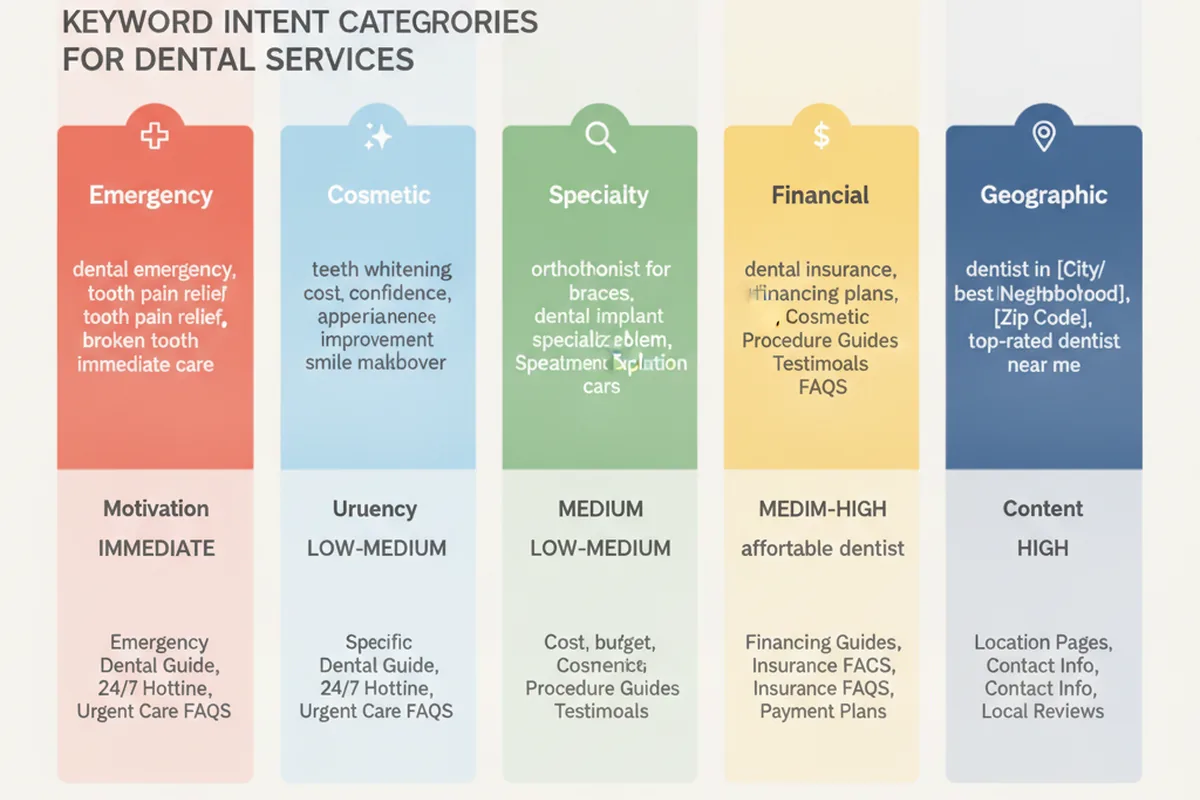
Dental keyword intent breaks into distinct categories, each reflecting different patient behavior and decision criteria. Recognizing these categories helps you prioritize which keywords to target and what content each one needs. Four keyword categories—emergency, cosmetic, specialty, and informational—each signal distinct patient intent and drive qualified leads at higher conversion rates than generic terms.
Emergency and Urgent-Care Keywords
Emergency and urgent-care keywords signal high intent because patients are in pain and seeking immediate help. Searches like “same-day emergency dentist,” “tooth pain relief in Peekskill,” and “emergency root canal” represent patients with an immediate need and high conversion likelihood. These searches often include geographic qualifiers because patients want the closest available provider. Emergency keywords are typically the fastest to convert and should be a priority for any practice that offers same-day or urgent care services.
Cosmetic and Aesthetic Keywords
Cosmetic keywords often include financing intent because aesthetic services are elective and price-sensitive. Patients searching “Invisalign payment plans,” “affordable teeth whitening,” or “cost of veneers” are considering a service but weighing the financial commitment. These searches reflect a longer decision timeline than emergency searches, but they signal genuine interest. Cosmetic keywords often perform better in suburban and higher-income areas where elective services have stronger demand.
Specialty and Condition-Specific Keywords
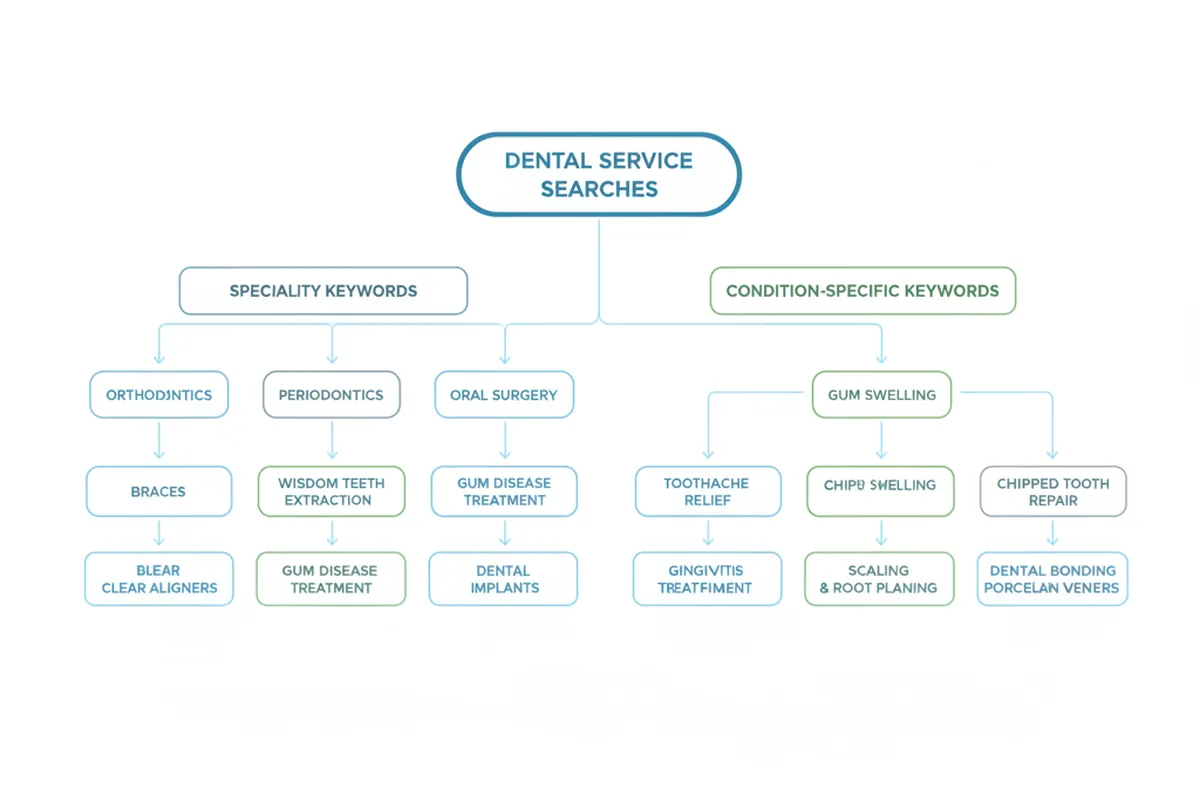
Specialty keywords vary by local orthodontic demand, pediatric population, and surgical referral patterns. A practice in a high-income area may see more cosmetic and clear-aligner searches, while a practice near a university may see more emergency and student-budget searches. Pediatric practices benefit from keywords like “pediatric dentist for anxious children” or “kid-friendly dental office,” while orthodontic practices target “teen braces cost” or “adult orthodontics without metal braces.” Understanding your local patient population helps you identify which specialty keywords matter most for your practice.
Aligning Keywords to the Services Your Practice Actually Offers
The most common keyword mistake is targeting searches for services your practice doesn’t provide. A general dentistry practice that doesn’t offer orthodontics shouldn’t invest in content for “Invisalign in Peekskill,” even if the search volume is high. This wastes effort and frustrates patients who land on your site expecting a service you don’t deliver. How to align keyword research with actual service offerings and local market conditions requires a straightforward audit process that connects what patients search for to what your practice can deliver.
Conduct a keyword-to-service audit by following these steps:
- List all services your practice currently offers, from routine cleanings to specialty procedures.
- Identify keywords that match each service category you provide.
- Deprioritize or skip keywords for services you don’t offer, even if search volume appears attractive.
- If you’re planning to add a new service, flag related keywords as strategic priorities for future content.
- Map each keyword to the appropriate page type: service page, blog post, or FAQ section.
This alignment ensures every piece of content you create serves a real patient need your practice can fulfill.
Incorporating Location and Geographic Keywords
Local search intent requires both broad area keywords and neighborhood-specific keywords. A practice in Peekskill should optimize for “dentist in Peekskill,” “dentist in Westchester County,” and potentially broader searches from patients in the surrounding area. The geographic scope depends on your service radius and local competition. Urban practices often see strong performance from “near me” searches because patients want the closest option. Suburban practices may see better results from broader area keywords because patients are willing to travel slightly for the right provider.
Include geographic qualifiers in your service pages and blog posts naturally. A page about emergency dental care should mention your location and service area. This helps search engines connect your content to local patient searches without forcing awkward phrasing.
Prioritizing Keywords When Content and Budget Are Limited
Practices with limited content capacity should prioritize keywords based on four criteria: alignment with services offered, local search volume and competition, current ranking position, and conversion likelihood. Start by identifying keywords where your practice already ranks in the top 20 results. These are quick wins that require less effort to move into the top three. Next, target high-intent keywords with moderate local competition where you can realistically rank within three to six months.
Next, target high-intent keywords with moderate local competition where you can realistically rank within three to six months. Avoid chasing highly competitive generic terms unless you have significant content budget and patience. Long-tail keywords (more specific, multi-word phrases) typically have lower volume but higher conversion rates and less competition. A practice often sees better returns optimizing five to ten high-intent long-tail keywords than chasing a single generic term.
For example, “emergency dentist same-day appointment” has lower volume than “dentist,” but it converts at a much higher rate and faces less competition.
From Keywords to Content: Building Your Strategy
Examples of high-intent keyword patterns across common dental services show how different patient needs map to different content types. High-intent keywords typically need service pages where the practice describes the service, explains the process, addresses common concerns, and includes a clear call to action (phone number, appointment booking, contact form). A patient searching “clear aligner cost” expects to land on a page about clear aligners, not a generic homepage.
Informational keywords can be addressed in blog posts or FAQs—for example, “how long do braces take” works well as a blog post or FAQ section that educates patients and builds trust. Organize keywords into clusters based on topic and intent. A cluster might include “emergency dentist,” “same-day dental appointment,” “tooth pain relief,” and “emergency root canal.” These keywords can all be addressed on a single emergency care service page or in related blog posts that link to each other.
This approach prevents duplicate content, makes your site structure clearer, and helps search engines understand your content depth on each topic.
Key Considerations for Dental Keyword Strategy
Dental keyword demand varies seasonally and geographically. More cosmetic searches occur before holidays when patients want to improve their appearance for social events. Emergency searches spike during stress periods and seasonal illness. Urban practices see more “near me” searches; suburban practices see broader area searches. Understanding these patterns helps you time content creation and adjust your strategy by season and location.
Keyword strategy is an ongoing practice, not a one-time exercise. As your practice grows, your service offerings change, and local competition shifts, your keyword priorities should evolve. Review your keyword performance quarterly and adjust your content plan based on what’s working. For deeper guidance on building a sustainable search visibility strategy, explore Seo Practices Dental, which covers the full framework for aligning keyword strategy with your practice’s growth goals.
Next Steps: Implementing Your Keyword-Focused Content Plan
Begin with a keyword audit of your current content. Identify which keywords your practice already ranks for, find service-keyword gaps (services you offer but don’t target in search), and list quick wins (keywords with high conversion likelihood and low current competition). Prioritize three to five high-intent keywords to target in the next quarter. For each keyword, decide whether it needs a new service page, a blog post, or an update to existing content. This focused approach delivers results without overwhelming your team.
Conclusion: Keyword Strategy as Your Competitive Edge
Practices that match keywords to patient intent and their own services gain a sustainable advantage over competitors chasing generic volume. This strategy is achievable without expensive tools or agencies. By understanding what your patients search for, aligning those searches to your services, and organizing your content around high-intent keywords, you build a foundation for steady patient acquisition and growth.
Summary
High-intent keywords—searches reflecting specific patient problems, decision stages, and service needs—drive qualified leads at higher conversion rates than generic terms. Dental keyword intent divides into emergency, cosmetic, specialty, and informational categories, each with distinct patient behavior and content needs. Align keywords to services your practice actually offers, prioritize by conversion likelihood and local competition, and organize keywords into content clusters that match patient decision stages.
Keyword strategy is ongoing; review performance quarterly and adjust as your practice and local market evolve. This approach delivers competitive advantage without massive budgets or agency dependence.
FAQ
What’s the difference between high-intent and generic dental keywords?
Generic keywords like “dentist” attract casual browsers and rank low on conversion. High-intent keywords like “emergency dentist same-day appointment” reflect specific patient problems and decision readiness, converting at much higher rates. High-intent keywords are more specific, often longer, and directly match what patients search when they’re ready to book or call.
How do I know which keywords match my practice’s services?
List the services your practice offers, then identify keywords that match each one. A practice offering emergency care should target emergency keywords; a practice offering clear aligners should target cosmetic and financing keywords. Avoid targeting keywords for services you don’t provide, as this wastes effort and frustrates patients.
Should I focus on local keywords or broader area keywords?
Both. Optimize for your specific location (such as “dentist in Peekskill”) and broader area keywords (such as “dentist in Westchester County”) based on your service radius. Urban practices benefit more from “near me” searches; suburban practices often see better results from broader area keywords. Your local competition and patient behavior should guide the balance.
How many keywords should I target if my content budget is limited?
Prioritize three to five high-intent, long-tail keywords with moderate local competition and high conversion likelihood. Focus on keywords where you already rank in the top 20 (quick wins) before tackling highly competitive terms. Long-tail keywords typically deliver better returns than chasing a single generic term.
What content format works best for different keyword types?
Service pages work best for high-intent keywords like “emergency dentist” or “clear aligner cost” because patients expect detailed service information and booking options. Blog posts and FAQs work better for informational keywords like “how long do braces take” that educate patients and build trust before they’re ready to book.
How often should I review and update my keyword strategy?
Review keyword performance quarterly. Track which keywords drive traffic and conversions, identify service-keyword gaps, and adjust your content plan based on what’s working. As your practice grows and local competition changes, your keyword priorities should evolve to stay competitive.
Educational note: This article is a general guide to keyword strategy for dental practices. It does not replace professional SEO consultation or individualized marketing strategy for your specific practice. Keyword performance, search rankings, and patient acquisition results depend on many factors including local competition, your current online presence, content quality, and implementation consistency. Consult with a marketing professional to assess your practice’s unique situation and develop a tailored keyword strategy.


