

TLDR
A distinctive dental practice brand reflects your authentic clinical expertise, patient care philosophy, and practice values. Identify what genuinely sets your practice apart, then communicate that consistently through visual design, messaging, patient experience, and online reputation to attract ideal patients and build trust.
Search engine optimization helps dental and orthodontic practices appear in search results when prospective patients look for care online. For a broader overview, visit Seo Practices Dental.
In a crowded dental market, patients rely on brand signals to choose a practice. They search online, read reviews, visit your website, and form opinions about your credibility and trustworthiness long before scheduling an appointment. A strong personal brand reduces friction in that decision-making process and attracts patients who align with your practice philosophy rather than those shopping purely on price.
When your practice has a clear, distinctive brand, prospective patients understand what makes you different. They know your clinical focus, your approach to patient care, and whether your practice culture matches their expectations. This clarity builds confidence and increases the likelihood they’ll book an appointment.
Patients who choose you based on authentic brand alignment tend to be more satisfied, more likely to accept treatment recommendations, and more loyal long-term. A well-developed brand also reduces your patient acquisition cost. Instead of competing on price or relying on generic advertising, you attract patients who value what you specifically offer. These patients are easier to convert and less likely to shop around.
Table of contents
- Core Elements of a Dental Practice Brand Identity
- Identify Your Practice’s Unique Value Proposition
- Building Your Visual Brand Identity
- Develop Authentic Messaging and Voice
- Align Brand Experience Across All Touchpoints
- Leverage Reviews and Reputation in Your Brand Strategy
- Avoid Common Dental Practice Branding Mistakes
- Key Considerations for Your Practice
- Summary
- FAQ
Core Elements of a Dental Practice Brand Identity
A complete brand identity rests on four interconnected pillars: visual identity, messaging, patient experience, and reputation. Together, these elements form your practice’s distinctive identity in the market.
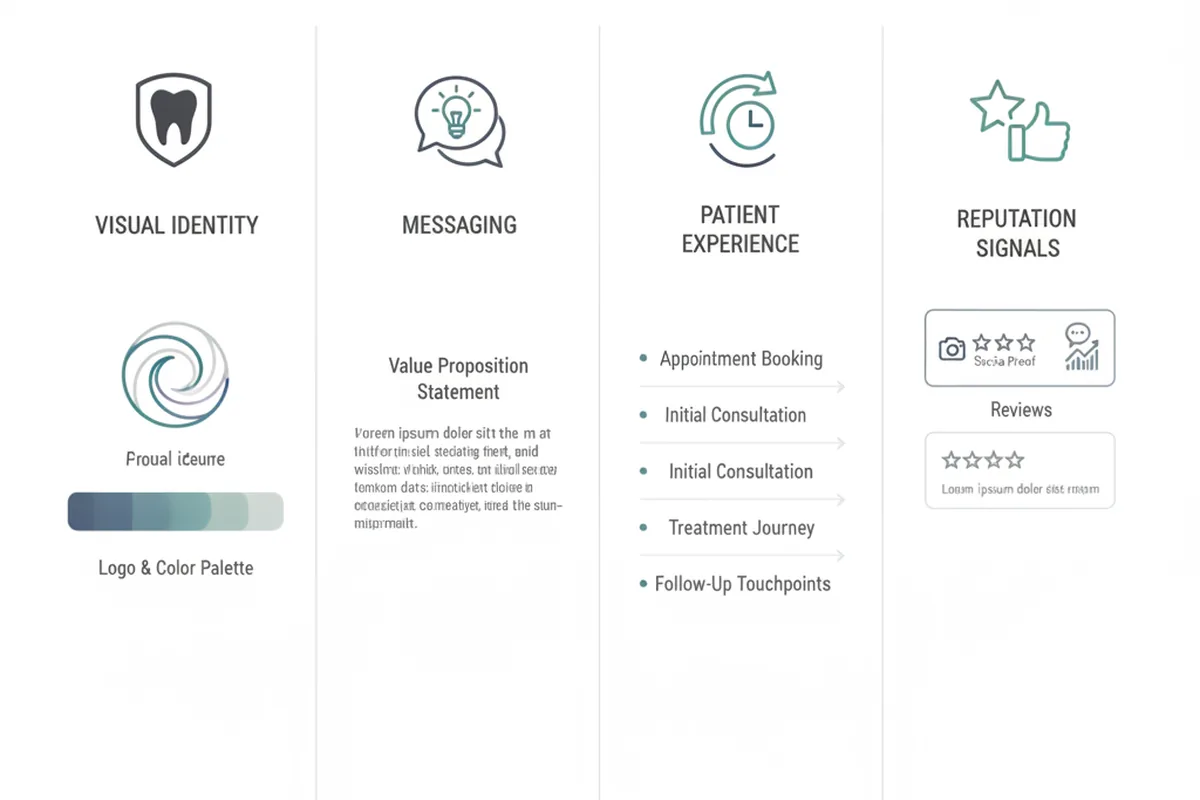
Visual Identity
Your visual brand includes your logo, color palette, typography, and imagery style. These elements create an immediate impression and signal professionalism, warmth, or innovation depending on your choices. Consistency in visual branding across your website, social media, business cards, and in-office signage reinforces recognition and trust.
Messaging and Voice
Your messaging communicates your practice mission, values, and unique approach to patient care. This includes your tagline, the language you use on your website and social media, and how you describe your services. Your voice should reflect your practice personality, whether you emphasize cutting-edge technology, compassionate care, family-friendly service, or specialized expertise.
Patient Experience
Brand experience extends far beyond your logo. It encompasses every interaction a patient has with your practice: how easy your website is to navigate, how quickly you respond to inquiries, the comfort of your waiting room, the professionalism of your clinical team, and the follow-up communication after treatment.
Reputation and Online Presence
Your online reputation—reflected in reviews, ratings, testimonials, and social media engagement—is a critical part of your brand. Prospective patients trust peer feedback as much as personal recommendations. A strong reputation signals quality and reliability.
Identify Your Practice’s Unique Value Proposition
Before you design a logo or write website copy, identify what genuinely differentiates your practice. This is your unique value proposition: the specific reason patients should choose you over competitors.
Start by examining your clinical expertise and treatment focus. Do you specialize in complex cases, cosmetic dentistry, pediatric care, or orthodontics? Are you known for a particular technique or technology? Your clinical strengths often form the foundation of your differentiation.
Next, consider your patient care philosophy. Do you prioritize comfortable experiences, comprehensive treatment planning, or patient education? Are you known for spending extra time with anxious patients or for making complex procedures feel simple? Your approach to care is a powerful differentiator because it directly affects patient satisfaction and loyalty.
Also reflect on your practice culture and team. Are you a family-owned practice with long-standing community ties? Do you have practitioners with unique backgrounds or credentials? Is your team known for exceptional communication or for creating a welcoming environment?
Finally, consider your community involvement and values. Are you committed to serving underserved populations, supporting local schools, or advancing dental education? Do you prioritize sustainability or use cutting-edge technology? Your values and community engagement can be powerful brand anchors if they’re authentic to your practice.
Your unique value proposition should be honest and specific. Avoid generic claims like “superior care” or “family-friendly”—every practice says that. Instead, articulate the specific combination of expertise, approach, and values that makes your practice distinctive.
Building Your Visual Brand Identity
Once you’ve identified your unique value proposition, translate it into visual form. Your visual brand should communicate your practice personality and values at a glance.
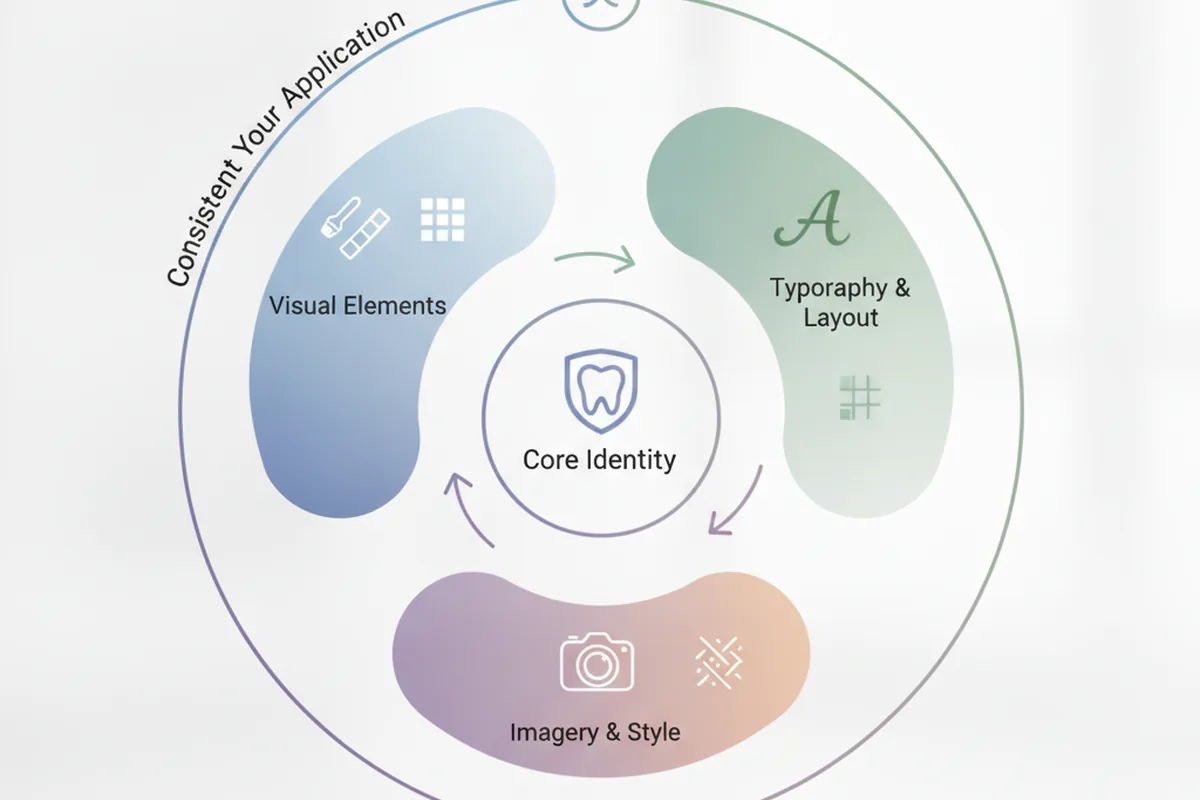
Start with your logo. A well-designed logo is memorable, professional, and appropriate for your practice type. It should work across different sizes and formats—on your website, business cards, social media, and signage. Aim for timeless, clean design that reflects your practice values rather than overly trendy designs that will feel dated quickly.
Your color palette is equally important. Colors evoke emotions and associations. Blues and greens suggest calm and trust; warm oranges and reds suggest energy and approachability; grays and blacks suggest sophistication and professionalism. Choose a primary color that reflects your practice personality, then select complementary colors for variety and visual interest.
Typography matters too. Your choice of fonts communicates professionalism and personality. Pair a distinctive primary font with a clean, readable secondary font for body text. Consistency in typography across your website, printed materials, and signage strengthens your visual brand.
Your imagery style—the photographs and graphics you use—should also be consistent. Decide whether you’ll use professional photography, illustrations, or a mix. Ensure your imagery reflects your practice values and appeals to your ideal patient. Consider investing in custom photography that shows your actual practice, team, and patients (with permission).
Document all these visual decisions in brand guidelines. These guidelines ensure that anyone creating materials for your practice maintains consistency. Brand guidelines typically include your logo usage rules, color codes, font specifications, imagery guidelines, and examples of correct and incorrect applications.
Develop Authentic Messaging and Voice
Your messaging is how you communicate your brand promise to patients. It should be clear, authentic, and consistent across all channels.
Start by defining your key messages: three to five core ideas you want patients to understand about your practice. Examples include “We specialize in complex orthodontic cases,” “We prioritize patient comfort and anxiety management,” “We use the latest digital technology,” or “We’re committed to making dentistry accessible to families.” Your key messages should flow directly from your unique value proposition.
Next, develop your brand voice—the personality and tone you use when communicating. Your voice should be consistent whether you’re writing website copy, responding to reviews, posting on social media, or speaking with patients in person. If your practice emphasizes warmth and approachability, your voice should be friendly and conversational. If you emphasize clinical expertise and precision, your voice should be professional and authoritative.
Your website copy, social media posts, and patient communications should all reflect your brand voice and key messages. Avoid generic dental language that could apply to any practice. Instead, use specific language that reflects your unique approach. For example, instead of “We provide quality dental care,” say “We take time to understand your concerns and create a treatment plan that works for your life.”
Consistency in messaging builds trust and reinforces your brand. When patients hear the same core messages across your website, social media, reviews, and in-office conversations, they develop confidence in your practice identity.
Align Brand Experience Across All Touchpoints
Your brand is only as strong as its weakest touchpoint. A beautiful website won’t overcome a chaotic in-office experience, and great social media won’t compensate for a confusing appointment booking process. Seamless brand alignment across all patient touchpoints is essential.
Start with your website. It’s often the first impression prospective patients have of your practice. Your website should clearly communicate your unique value proposition, reflect your visual brand identity, use your brand voice, and make it easy for patients to book an appointment or contact you. Your website is also where you establish credibility through testimonials, case studies, and information about your team and credentials.
Your social media presence should extend your brand voice and showcase your practice personality. Share content that educates patients about oral health, highlights your team and practice culture, and demonstrates your clinical expertise. Respond to comments and messages in your brand voice. Use your visual brand elements consistently.
Your online reviews and reputation are part of your brand experience. When prospective patients read reviews, they’re evaluating your brand promise. Positive reviews that mention specific aspects of your care reinforce your brand. Respond professionally to all reviews, positive and negative. Your responses demonstrate your commitment to patient satisfaction and your brand values.
Your in-office experience is where your brand comes to life. From the moment a patient enters your practice, every detail communicates your brand. Is your waiting room clean and welcoming? Do your team members greet patients warmly? Is your clinical space modern or cozy? Do you explain procedures clearly? Do you follow up after treatment? These experiences either reinforce or contradict your brand promise.
Your patient communications—appointment reminders, follow-up emails, treatment recommendations—should also reflect your brand voice and values. Personalized, thoughtful communication reinforces your brand and builds patient loyalty.
Leverage Reviews and Reputation in Your Brand Strategy
Online reviews are integral to your brand. Research shows that 91% of consumers read online reviews when searching for local businesses, and 88% of respondents trust online reviews as much as they do personal recommendations. Your reviews are essentially third-party validation of your brand promise.
Actively manage your reputation by encouraging satisfied patients to leave reviews. Make it easy for them by sending follow-up emails with direct links to review platforms. Respond professionally to all reviews—positive and negative. Thank patients for positive reviews and mention specific aspects of their experience that align with your brand.
For negative reviews, respond with empathy, take responsibility where appropriate, and offer to resolve the issue. Your responses show prospective patients that you’re committed to patient satisfaction and that you stand behind your brand promise.
Use positive reviews as brand proof points in your marketing. Feature testimonials on your website and social media. Highlight specific patient feedback that demonstrates your unique value proposition. For example, if a patient praises your ability to work with anxious patients, feature that testimonial prominently if anxiety management is part of your brand positioning.
Monitor your online reputation across review platforms, Google Business Profile, social media, and dental directories. Respond quickly to new reviews and address any patterns in feedback. If multiple patients mention the same concern, that’s valuable information for improving your practice and your brand experience.
Avoid Common Dental Practice Branding Mistakes
Many practices undermine their branding efforts by making preventable mistakes. Understanding these pitfalls helps you build a stronger brand.
- Inconsistent messaging: When your website, social media, and in-office experience communicate different things, patients become confused about what your practice actually offers. Establish clear key messages and ensure they’re reflected consistently across all channels.
- Underinvestment in visual design: A poorly designed logo, outdated website, or inconsistent visual branding signals that your practice isn’t professional or trustworthy. Invest in quality design that reflects your practice values and appeals to your ideal patient.
- Neglecting patient experience outside the clinical chair: Many practices focus on clinical excellence but neglect the patient experience in other areas—a confusing website, slow appointment booking, impersonal follow-up communication, or a chaotic waiting room. Every touchpoint matters to your brand.
- Competing on price alone: Practices that emphasize low cost over unique value proposition attract price-sensitive patients who are likely to leave for a cheaper competitor. A distinctive brand attracts patients who value what you specifically offer, not just the lowest price.
- Neglecting reputation management: Practices that don’t actively manage their online reviews miss opportunities to reinforce their brand and address patient concerns. Ignoring negative reviews signals that you don’t care about patient feedback.
- Copying generic templates: Using generic dental marketing templates or copying competitors’ messaging makes your practice indistinguishable. Your brand should reflect your unique value proposition, not a template.
Key Considerations for Your Practice
Your brand will evolve as your practice grows. Revisit your brand positioning periodically—at least annually—to ensure it still reflects your practice values and appeals to your ideal patient. As you add new services, team members, or locations, consider how these changes affect your brand and whether your messaging and visual identity need adjustment.
For practices in Peekskill and beyond, building a distinctive brand is foundational to sustainable growth. A strong brand reduces your reliance on price-based competition, attracts ideal patients, and builds loyalty that supports long-term practice success.
Explore resources on Seo Practices Dental, learn about Dentist Keywords, review best practices for Orthodontic Websites, and discover how to 5 Ways To. You can also dive deeper into Personal Brand tailored to dental practices.
Summary
A distinctive brand identity is your competitive advantage in a crowded dental market. Your brand encompasses your visual identity, messaging, patient experience, and online reputation—all working together to communicate your unique value proposition and build patient trust. Identify what genuinely differentiates your practice, then translate that into consistent visual branding, authentic messaging, and seamless patient experience across all touchpoints.
Actively manage your online reputation and avoid common branding mistakes like inconsistent messaging, underinvestment in design, or competing on price alone. As your practice grows, maintain brand consistency while allowing your positioning to evolve with your practice. A well-developed brand attracts ideal patients, reduces acquisition costs, and supports sustainable practice growth.
Educational note: This article is a general guide to dental practice branding. It does not replace individualized advice tailored to your specific practice, market, or patient demographics. Brand positioning, design choices, and messaging strategies should be developed in consultation with professionals who understand your practice goals and competitive environment. Results and outcomes vary based on implementation, market conditions, and ongoing management of your brand across all touchpoints.
FAQ
What makes a dental practice brand distinctive?
A distinctive brand reflects your authentic clinical expertise, patient care philosophy, and practice values, not generic dental marketing templates. It’s built on a clear understanding of what genuinely differentiates your practice, whether that’s specialized expertise, a unique approach to patient care, your team’s background, or your community involvement. Consistency across visual identity, messaging, patient experience, and online reputation reinforces that distinctiveness.
How do I identify my practice’s unique value proposition?
Start by examining your clinical strengths and treatment focus, your approach to patient care, your team’s unique qualities, and your practice values and community involvement. Your unique value proposition should be specific and honest—the particular combination of expertise, approach, and values that makes your practice different. Avoid generic claims; instead, articulate what patients will actually experience when they choose your practice.
Why is consistency across touchpoints important for my brand?
Patients interact with your brand across multiple channels—your website, social media, reviews, and in-office experience. When these touchpoints communicate consistent messages and reflect your visual brand, patients develop confidence and trust. Inconsistency creates confusion and weakens your brand. Seamless alignment across all touchpoints reinforces your brand promise and builds patient loyalty.
How do online reviews affect my practice brand?
Online reviews are third-party validation of your brand promise. Research shows that 91% of consumers read online reviews when searching for local businesses. Positive reviews that mention specific aspects of your care reinforce your brand positioning. Actively encourage satisfied patients to leave reviews, respond professionally to all feedback, and use positive testimonials as brand proof points in your marketing.
What’s the biggest branding mistake dental practices make?
Many practices compete on price alone rather than building a distinctive brand around their unique value proposition. This attracts price-sensitive patients who are likely to leave for a cheaper competitor. A stronger approach is to invest in authentic brand positioning that attracts patients who value what you specifically offer, not just the lowest cost.
How should my brand evolve as my practice grows?
Revisit your brand positioning periodically—at least annually—to ensure it still reflects your practice values and appeals to your ideal patient. As you add services, team members, or locations, consider how these changes affect your brand. Document clear brand guidelines so that all team members can represent your brand consistently as your practice expands.


